



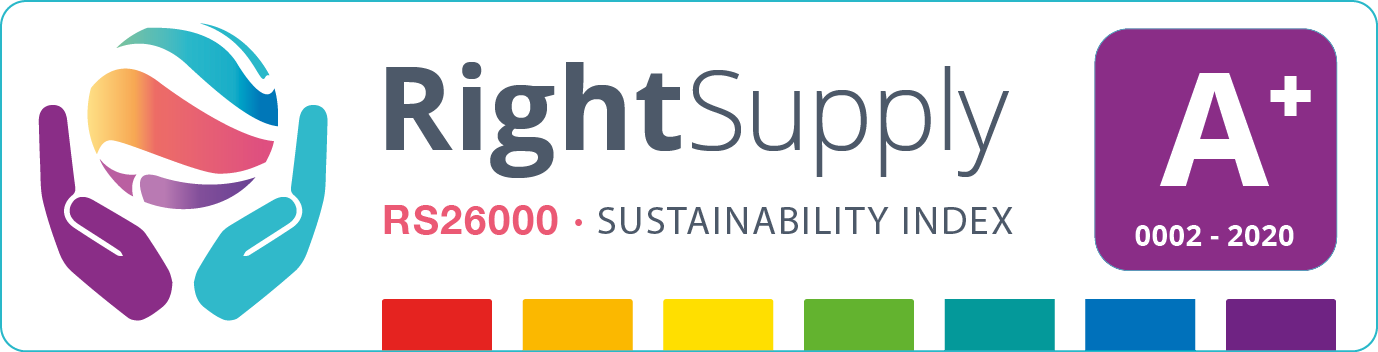
RS26000 Sustainability Report
2025
ALIER
![]() |

Descriptive data of the organization
Ref. VSME (CSRD-EU): A-B1.012

Corporate center.Headquarters of ALIER
Main activity center.
Ref. VSME (CSRD-EU): B1.006,, B1.007, B1.010 – GRI Standard: 2-1, 2-6, 2-7, 2-8
Organization and activities Alier is a century-old brand born in 1832. Paper manufacturers since 1886, in 1948 we began to contribute to post-consumer recycling processes by manufacturing 100% recycled paper and we like to think that, since then, we have filled many blank pages based on the circular economy. Evolution and respect are perhaps the two words that have guided us throughout this time. The ability to adapt to change, always with deep respect for the environment and sustainability, is also a defining characteristic of our work. PBecause, after all, recycling is evolving.
| Main product or service families | |||
PBL High Performance Paper
| Production volumes by product/service family | |||
| Ref. VSME (CSRD-EU): C1.001 |
HP PBL Paper/Packaging/Other: 100,681.26 Tons
MAIN WEBSITE: https://alier.com/
Social information
![]() |
![]() |
Link here to our main social media channels.
Ref. VSME (CSRD-EU): B1.011
Ref. VSME (CSRD-EU): A-B1.006 – GRI Standard: 102-46 /
Scope of the Right Supply 26000 Report
RS26000 REPORT COVERAGE
Manufacturing, recycling and valorization of paper from recovered materials.
SCOPE:
Factory and cogeneration plant, located at: Pol.Industrial S/N, Rosselló, Lleida. Controlled waste disposal site in the municipality of Rosselló.
Ref. VSME (CSRD-EU): C2.002 – GRI Standard: 2-9, 2-12, 2-14
Governance GOVERNANCE STRUCTURE: In February 2018, with the purchase of the majority of the share capital from part of the Alier family, the Pereira family, of Argentine origin, with a strong industrial profile and extensive experience in the manufacture of plasterboard, became part of the shareholders. They provided the company with new opportunities and a vision of the plasterboard business, which, together with ALIER, SA's papermaking tradition, has consolidated the company as an important player in the plasterboard paper market. The Management Committee holds monthly meetings where results are presented, decisions are made, the company's financial statements are reviewed, and the budget and strategic lines are monitored. The interaction between the different departments of the organization is a very strong point, as it provides: Regular meetings are held between the MA and Regulatory Department and Management to make decisions regarding the Integrated Management System (quality, Environment and energy) and regulations. Given this internal structure, to date there is no specific CSR department reporting directly to management, nor a management representative for this function. However, Alier's commitments in this area are addressed by all departments within the organization. In 2023, a new Sustainability Committee was established, comprised of members of the executive committee and those responsible for the ESG management areas. At the beginning of fiscal year 2024, the quality area was reorganized to help increase product quality and customer satisfaction, becoming the Continuous Improvement and Quality Department. Another important step in sustainability was the opening of the plastics plant in October 2024. Ref. GRI Standard: 2-3 Contact regarding this report CONTACT PERSON: Mrs. Isabel Vidal / Mr. Joan Luque – Post: Responsible for regulations, Environment and SGI Direct phone number: +34933042860 Email: ALIERLLE@ALIER.COM
ALIER has now officially signed the commitments of the UN Global Compact. This digital sustainability report serves as ALIER's commitment to progress and communication regarding good governance and corporate social responsibility, aligned with these principles and the Sustainable Development Goals of the United Nations' 2030 Agenda.
| Compliance with legal provisions |
| Ref. GRI Standard: 307 | ||
| ALIER has the corresponding authorizations / licenses / communications for the exercise of the activity. |
||
RSs: 10
| Legal Compliance Management |
| Ref. GRI Standard: 205, 307, 419 | ||
| ALIER has a Legal Compliance Management System, a Crime Prevention and/or Anti-Bribery/Anti-Corruption Management System |
||
| INFORMATION ON CASES OF NON-COMPLIANCE: They did not occur.
|
||
Ref. GRI Standard: 2-27
RSs: 20
| Ref. GRI Standard: 414 |
||
| Supplier sustainability assessment (including the core subjects of ISO 26000) | ||
| Supplier evaluations must be conducted annually or biannually and include at least 50% strategic, representative, or directly related suppliers involved in production or service provision. Their content must include: Human rights, labor practices, environment, fair operations, consumer/customer issues, community development, and corporate social responsibility governance | ||
| ALIER does not use the Right Supply platform for the evaluation of its suppliers. |
||
| Assessment of relevant or material impacts on the supply chain |
|
Ref. VSME (CSRD-EU): C1.003 – GRI Standard: 308 |
||
| ALIER conducts an environmental assessment of its suppliers on a regular and documented basis, on an annual basis. |
||
| RSs: 25 | ||
References to the standard GRI Standard They are included in the RS26000 report for guidance purposes.
|
Our commitment and values |
It is a pleasure for the entire ALIER team to present this digital sustainability report, as a further step in shaping our communication on environmental, social and corporate governance matters following a structure based on international standards. In the coming years, our non-financial statements will also be adapted to the new European directive on sustainability reporting and its new indicators. Therefore, this document also incorporates references to other international standards, such as the content of the Global Reporting Initiative guidelines and the Sustainable Development Goals of the 2030 Agenda. In consideration of all our stakeholders, we present this report which we hope will be of interest and use to you.
Ref. GRI Standard: 2-22
Ref. VSME (CSRD-EU): B2.003, B2.001 – GRI Standard: 102-16
Sustainability Policies
DOCUMENTED COMMITMENTS: 202302 ALIER POLICIES 2022
Codes of ethics
Ref. VSME (CSRD-EU): C6.001 to C6.007
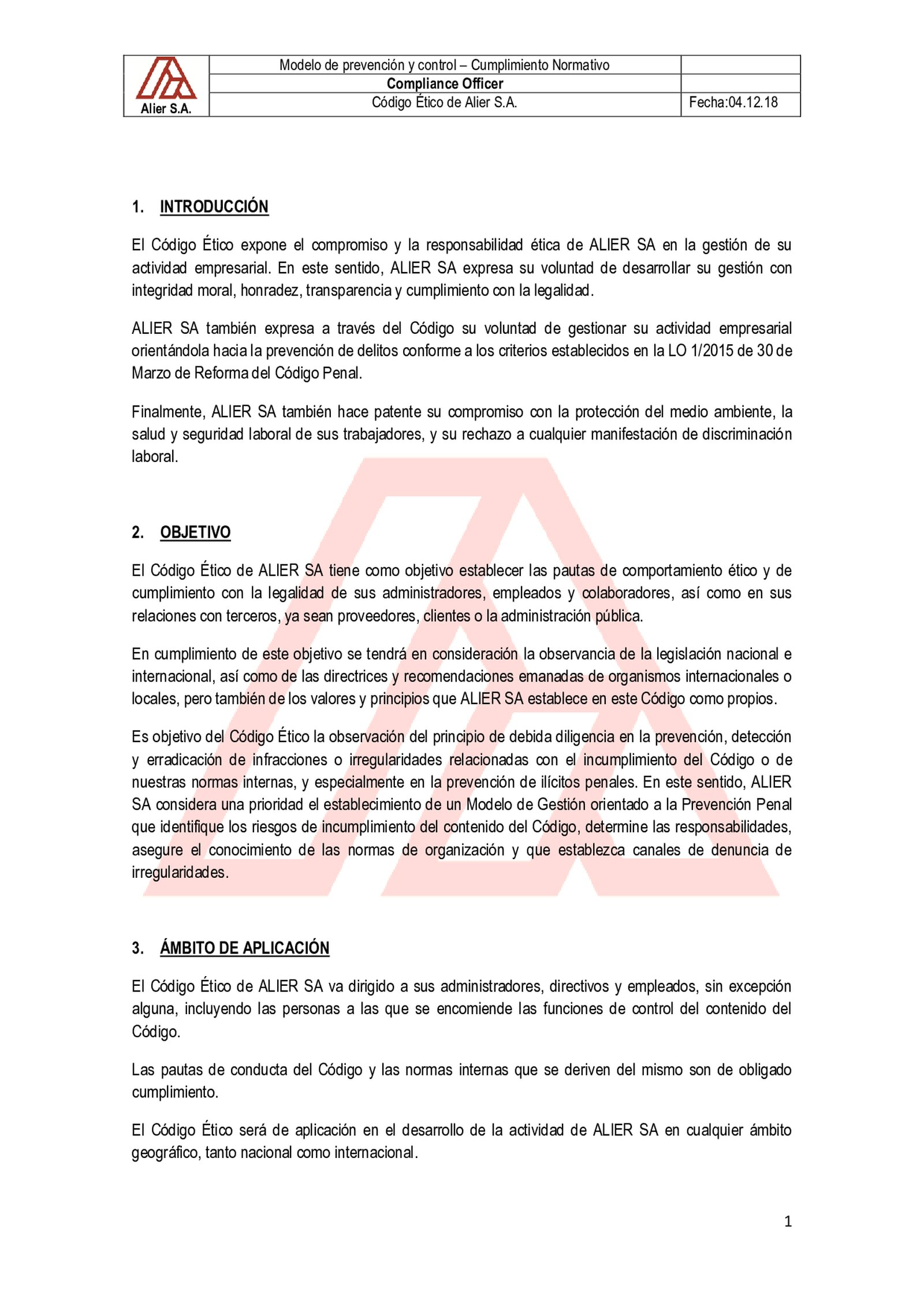
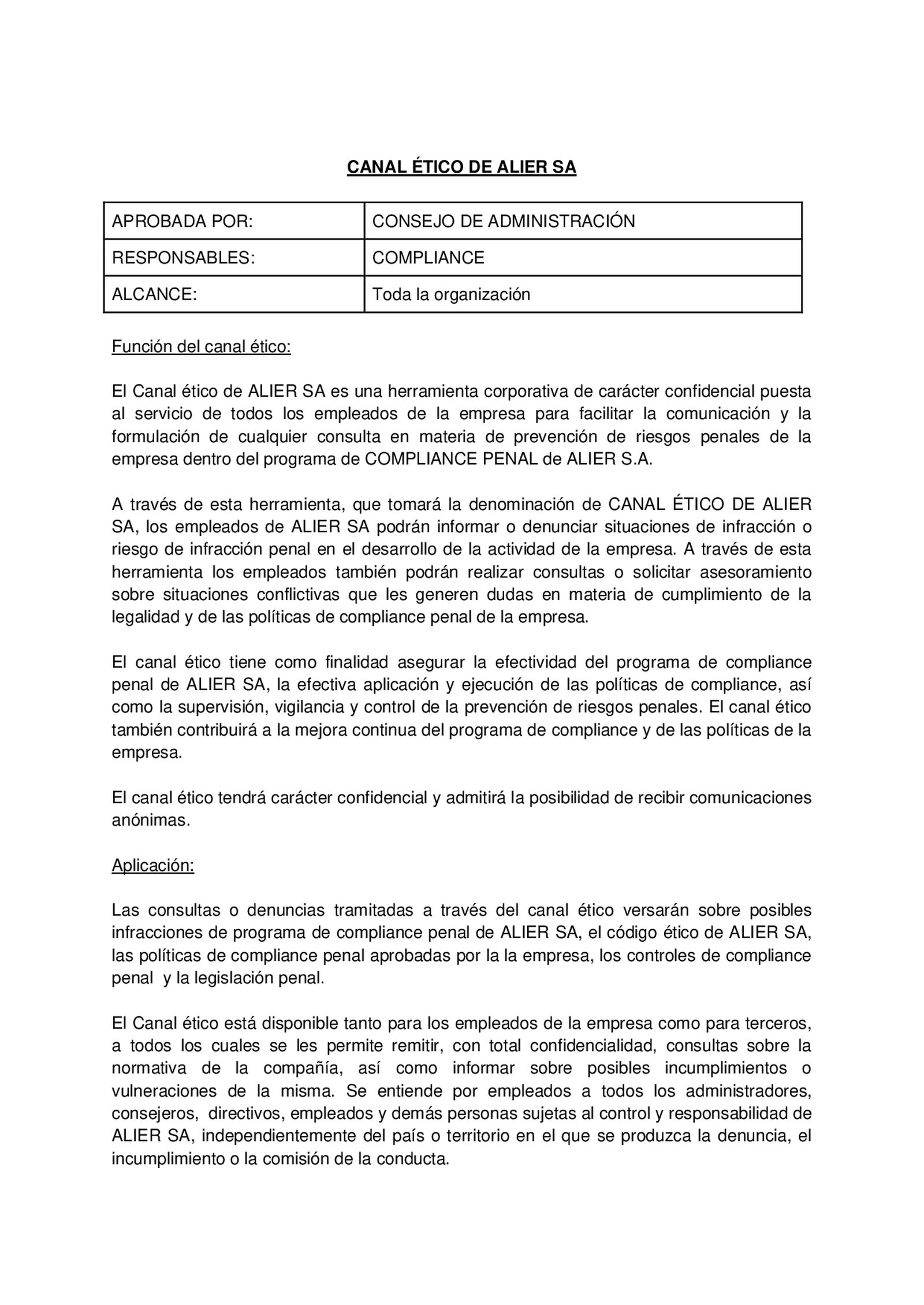
CODE OF ETHICS: ETHICS CHANNEL Alier's Code of Ethics
Adherence to the principles of Corporate Social Responsibility of the ISO 26000 standard
Our organization is committed to the Sustainable Development Goals of the 2030 Agenda.
To this end, it adopts the principles established by the ISO 26000 standard as a Guide to Social Responsibility
- Accountability
- Transparency
- Ethical behavior
- Respect for the interests of stakeholders
- Respect for the principle of legality
- Respect for international standards
- Respect for Human Rights
Strategy and key sustainability elements taken into account
Ref. VSME (CSRD-EU): C1.004
Ref. GRI Standard: 2-23
Adherence to the principles of the Global CompactThe organization is committed to the following principles, whether or not it is officially registered with the Global Compact. Joining or maintaining participation is recommended.
| 1 | ALIER It supports and respects the protection of internationally recognized fundamental human rights within our sphere of influence. |
| 2 | ALIER It claims not to provide cover or complicity to other companies that violate Human Rights. |
| 3 | ALIER It is committed to freedom of association and the effective recognition of the right to collective bargaining. |
| 4 | ALIER It is committed to the elimination of all forms of forced or compulsory labor. |
| 5 | ALIER is committed to eradicating child labor. |
| 6 | ALIER It is committed to the abolition of discriminatory practices in employment and occupation. |
| 7 | ALIER It maintains a preventive approach that favors the protection of the environment. |
| 8 | ALIER It encourages initiatives that promote greater environmental responsibility. |
| 9 | ALIER It promotes the development and dissemination of environmentally friendly technologies. |
| 10 | ALIER It establishes functions and controls to ensure the absence of corruption in all its forms, including extortion and bribery. |
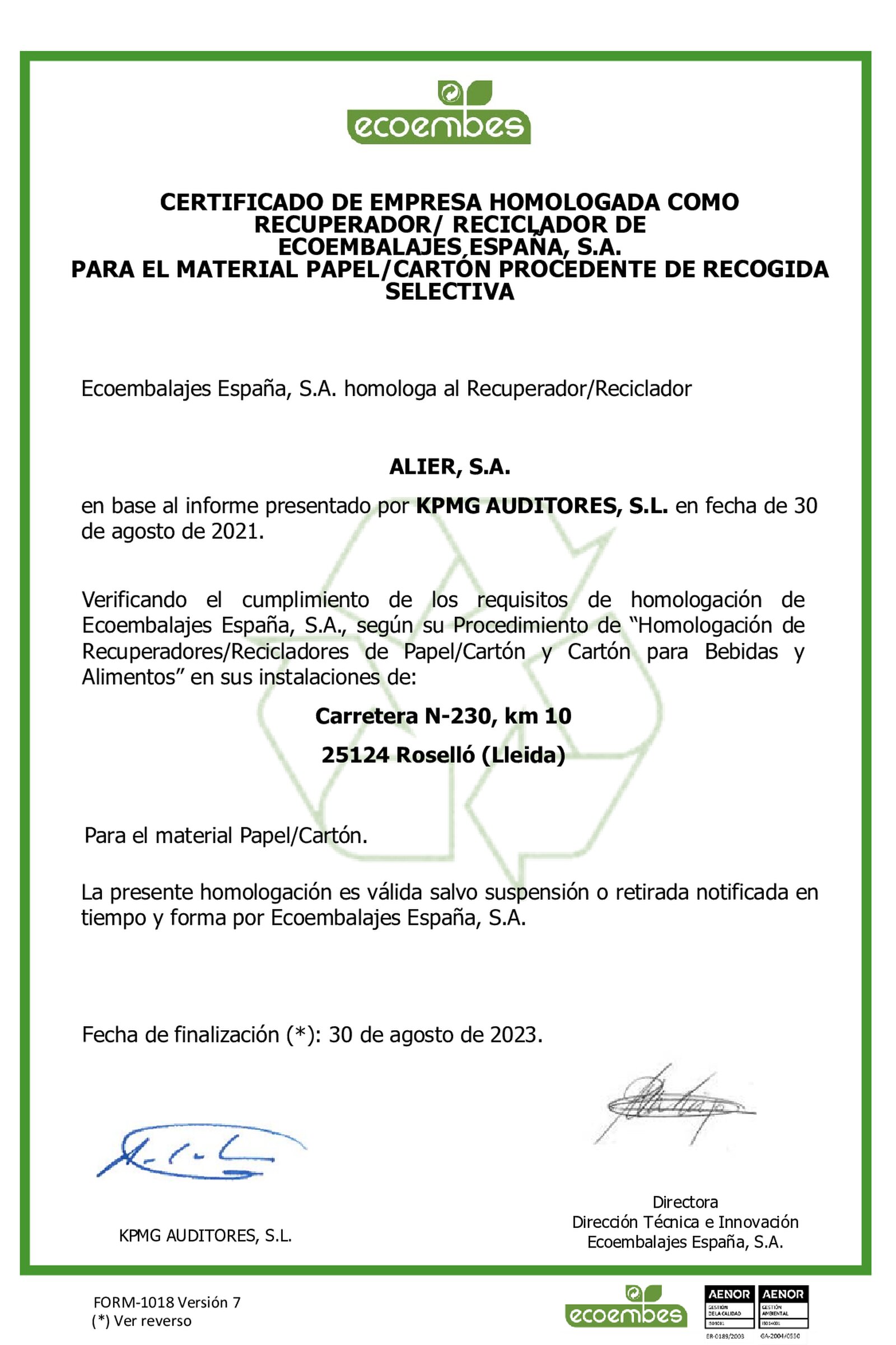
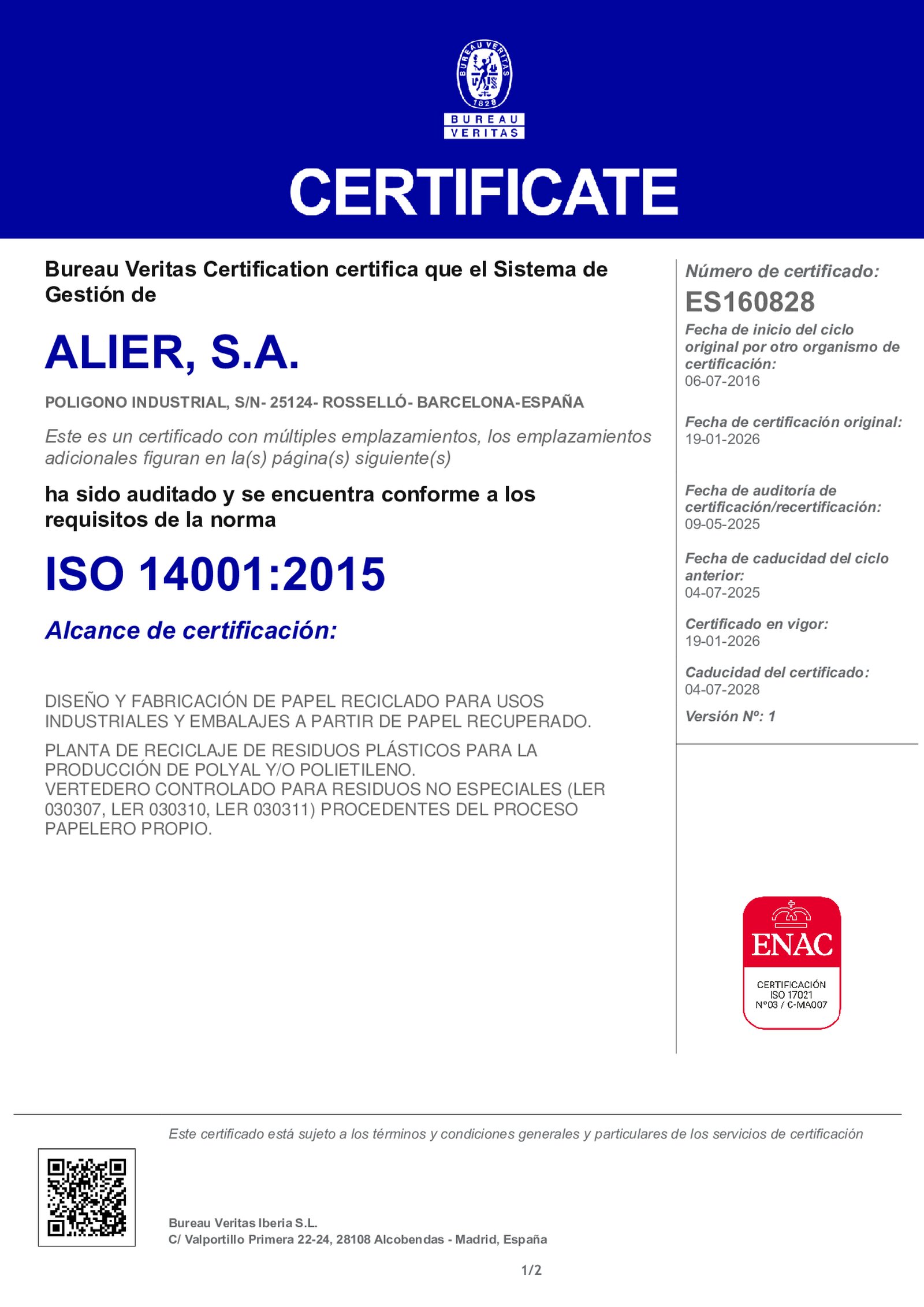
| Certifications accredited by ALIER |
Ref. VSME (CSRD-EU): B1.005 – GRI Standard: 3.3d
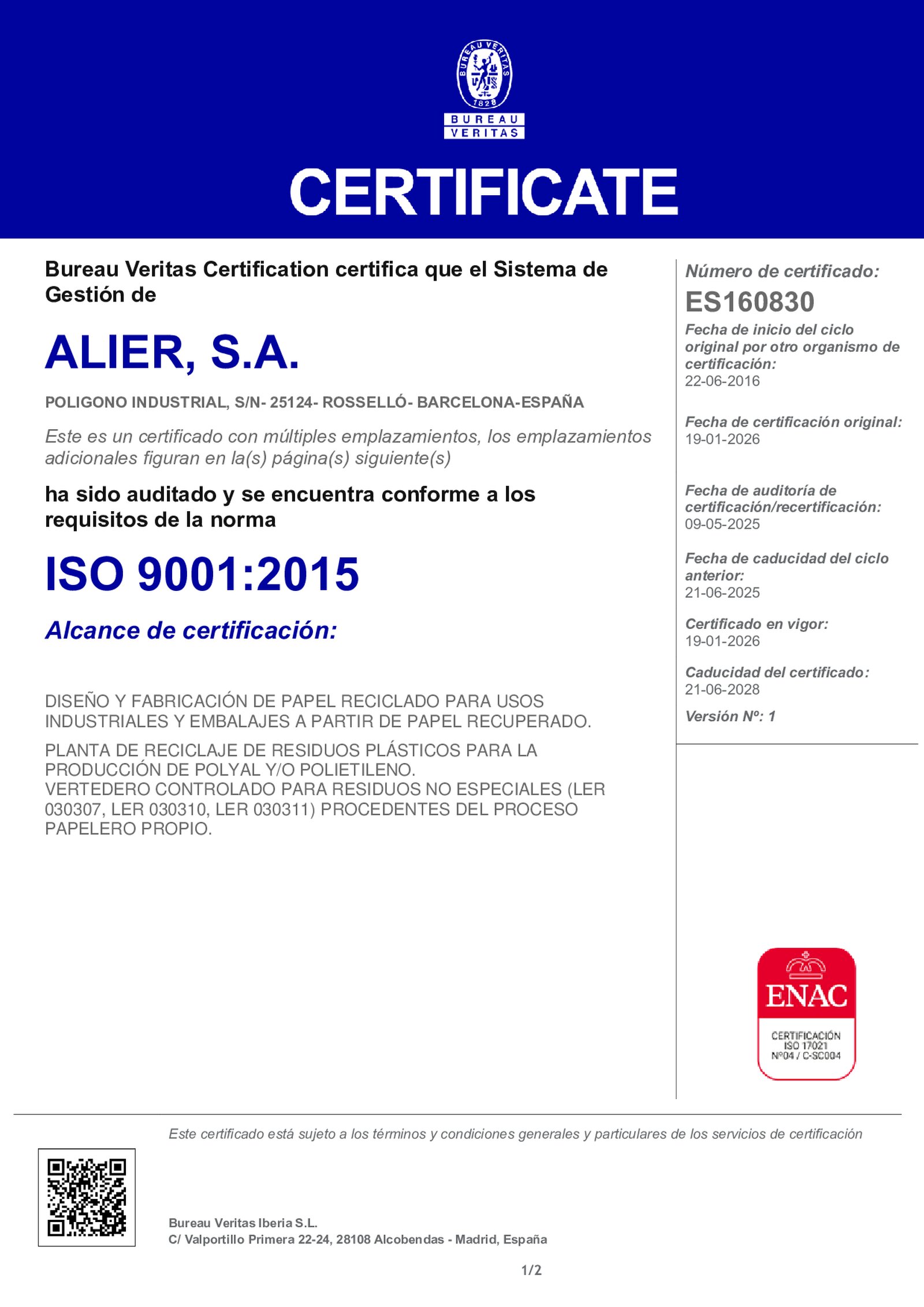
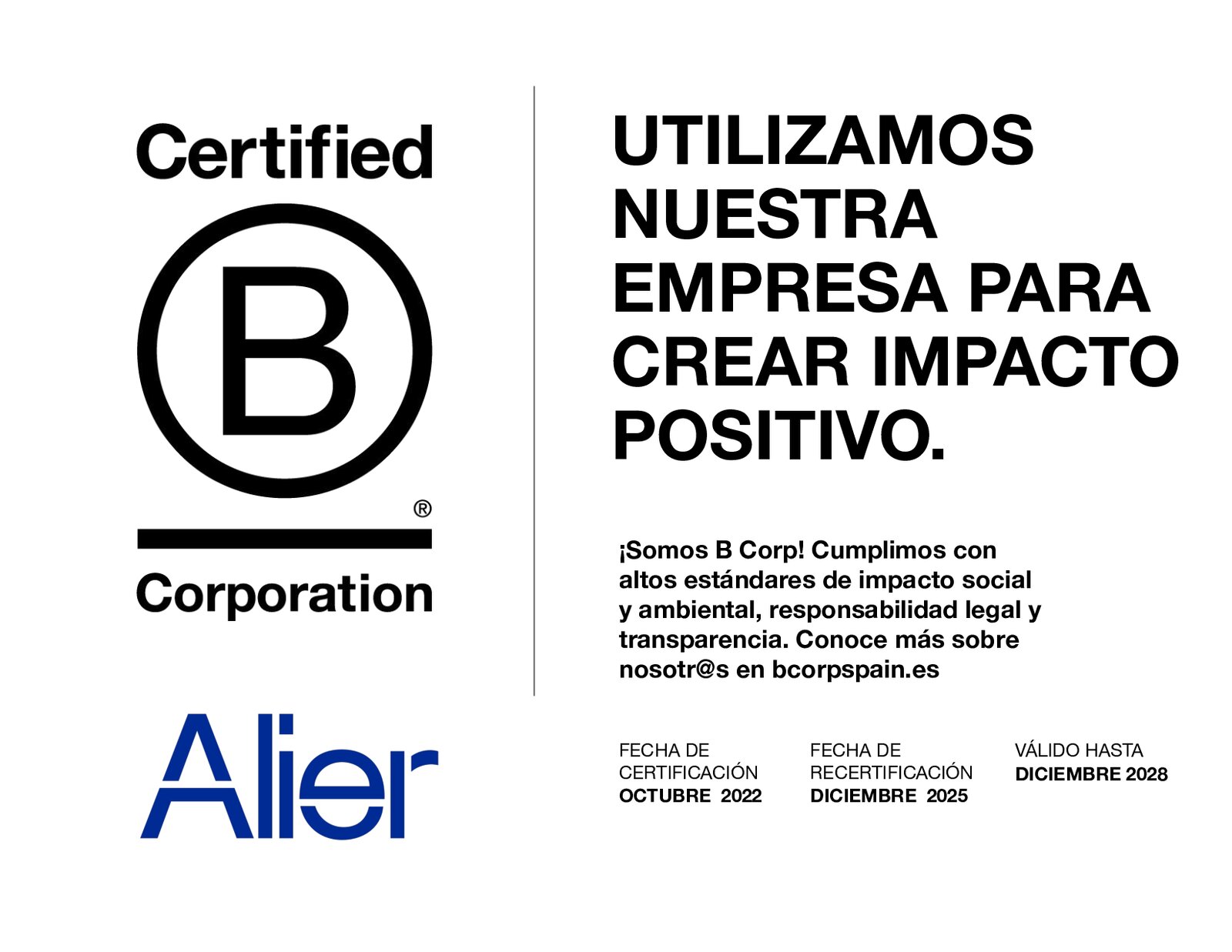
The icons included here are intended to recognize the certificates accredited by the organization, and do not constitute a faithful representation of its graphic brands or its guarantee seals.
ENVIRONMENTAL MANAGEMENT
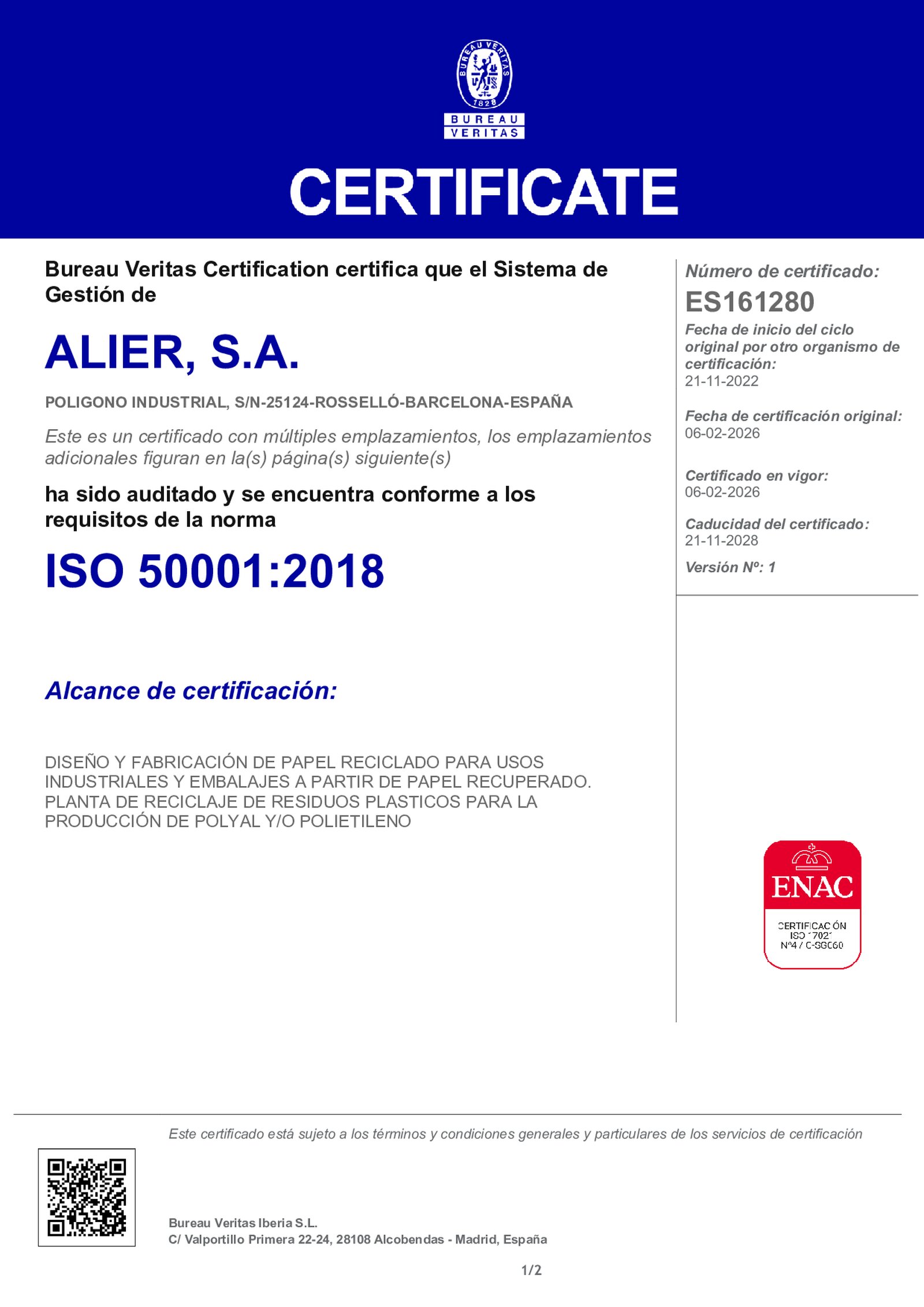
ISO 50001 ENERGY MANAGEMENT
⚪ RSs: 280
Environmental Sustainability in the Value Chain
| Agenda 2030Mapping of the Sustainable Development Goals |
Ref. VSME (CSRD-EU): B1.011, C1.002, C1.003 – GRI Standard: 2-7, 301-01
| GEOLOCATION OF HUMAN CAPITAL AND KEY RESOURCES | SPECIFIC INFORMATION |
Ref. GRI Standard: 301-1 Origin of the main raw materials: Origin of the main products distributed:
⚪ Post-consumer recycled paper 100%:Spain
⚪ HP PBL Paper/Packaging/ Others:Spain
Ref. GRI Standard: 3-3
Description of the main actual and potential impacts:
Environmental impact from the consumption of natural resources such as water, gas, and biomass.
| AGENDA 2030 AND LIFE CYCLE PERSPECTIVE | |
| Location of the SDGs in the different phases of the product or service life cycle. |
EXTRACTION AND TRANSPORT OF RAW MATERIALS
SDGs Agenda 2030
INTERMEDIATE MANUFACTURING OF COMPOUNDS/COMPONENTS
SDGs Agenda 2030
OWN MANUFACTURING AND PROVISION
SDGs Agenda 2030
LOGISTICS, TRANSPORT AND DISTRIBUTION
SDGs Agenda 2030
CUSTOMER AND CONSUMER USE
SDGs Agenda 2030
DISPOSAL, RECYCLING AND REUSE
SDGs Agenda 2030
Ref. GRI Standard: 3-3d
| Standardized Environmental Management Equipment and Systems |
| ALIER has a team with exclusive features in the area of sustainability. |
||
| ALIER has working groups or management committees that plan actions related to sustainability. |
||
| ALIER has a welcome and training plan in sustainability. |
||
| ALIER has an environmental management system certified under the ISO 14001 standard. |
||
| ALIER has implemented actions to reduce its environmental impacts. |
||
| ALIER internally audits its environmental management and receives external audits in this area. |
||
| RSs: 77 | ||
| Standardized Energy Management Systems |
| ALIER has an Energy Management System under the ISO 50001 standard. |
||
| RSs: 10 | ||
| Buy Green (supplies, equipment, facilities,machinery, raw materials or auxiliary materials). |
| |
ALIER applies green purchasing criteria in the acquisition of more than 50 % of total purchase volume. |
|
| Our fleet of vehicles does NOT include electric vehicles. |
||
| RSs: 20 | ||
| Sustainable mobility plans |
| ALIER has not implemented any mobility plan among its employees to reduce the impact on transportation. |
||
| RSs: 0 | ||
| Sustainable buildings and infrastructure |
| ALIER does not have any certification of efficiency or sustainability of its infrastructure and buildings. |
||
| RSs: 0 | ||
| Other non-standard environmental management systems |
| Environmental design and development of products and services |
| The products/services provided by ALIER have certifications that guarantee officially recognized environmental improvements. |
||
| Environmental and sustainability improvements introduced in the design of the product or service |
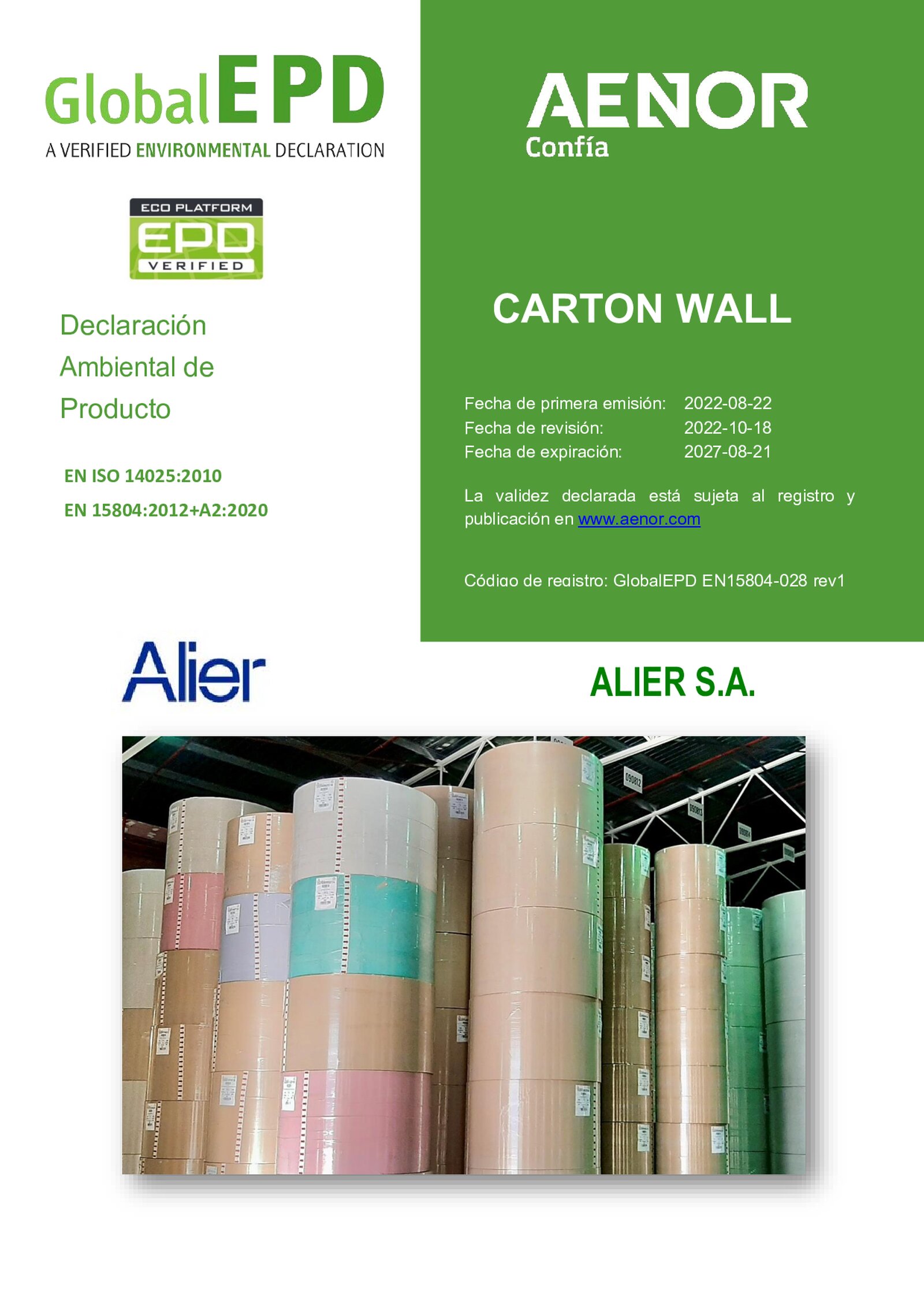
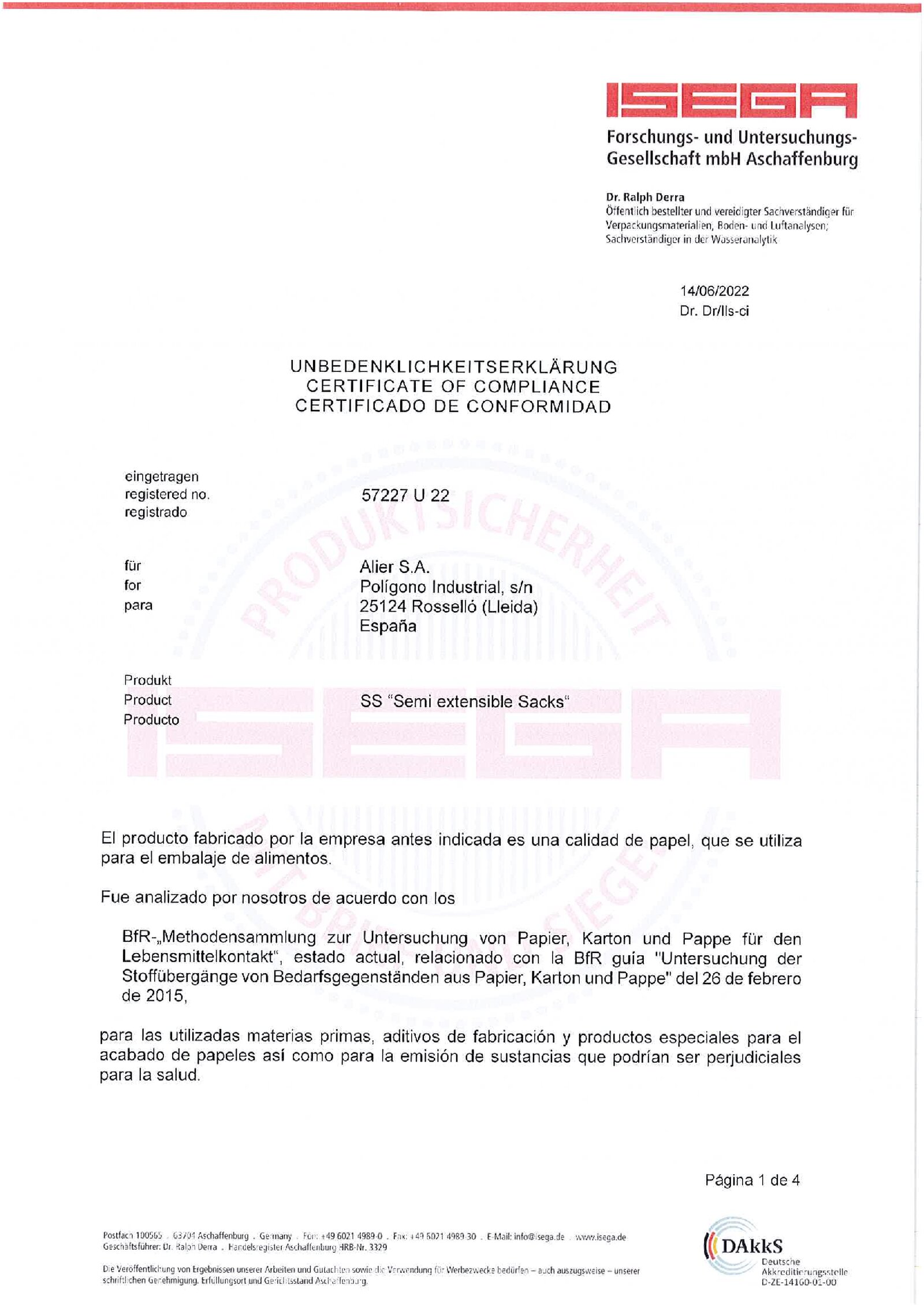
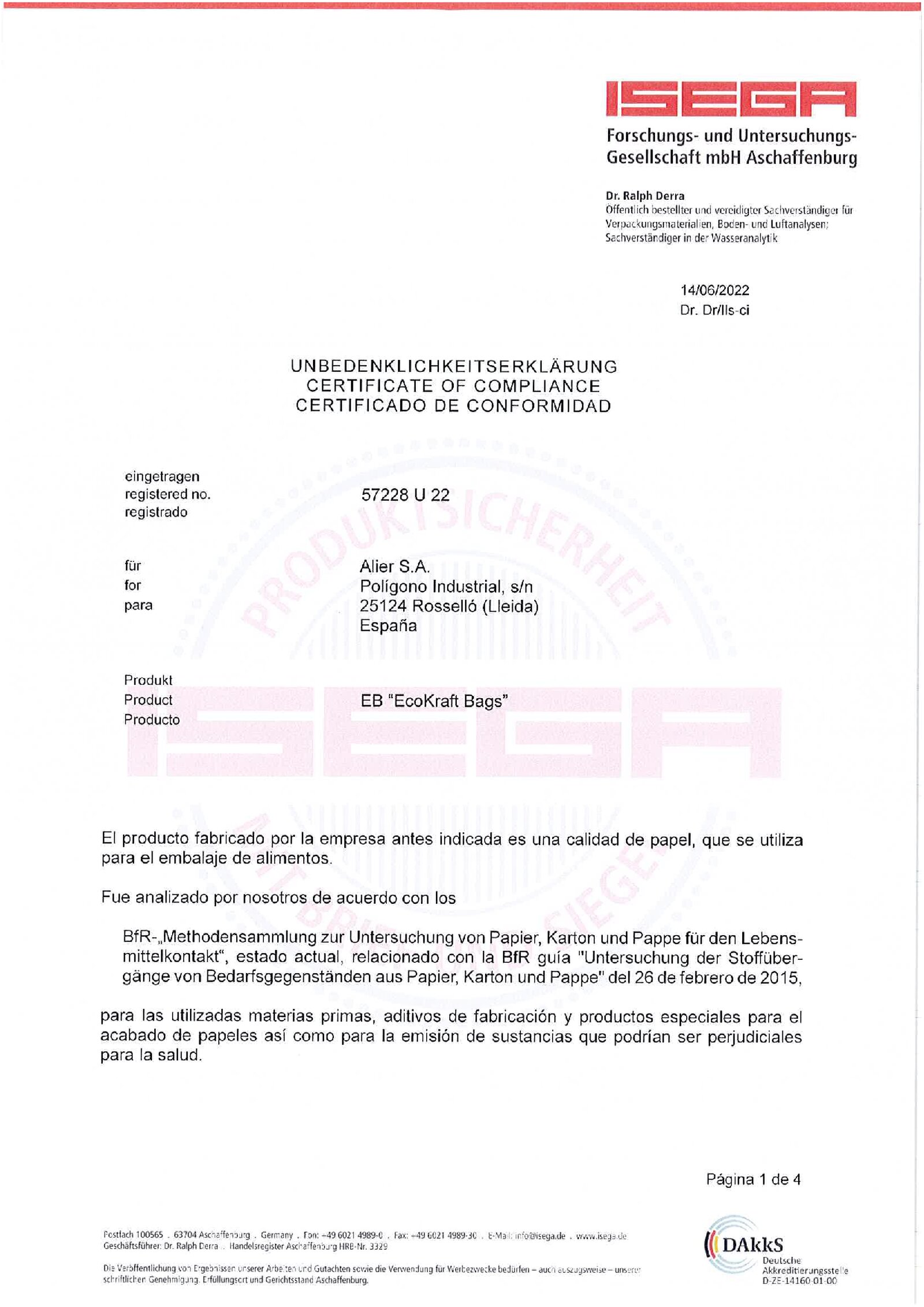
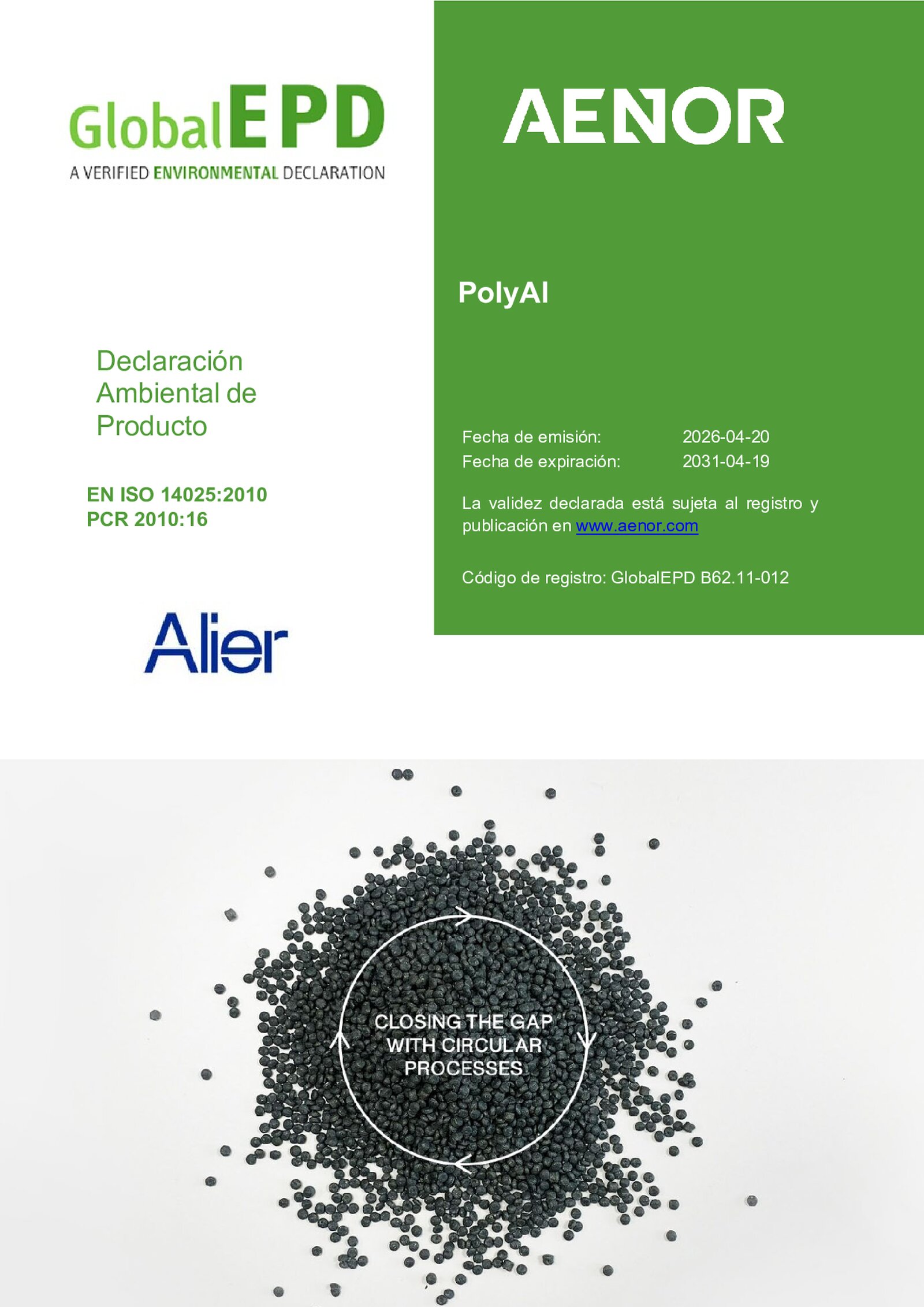
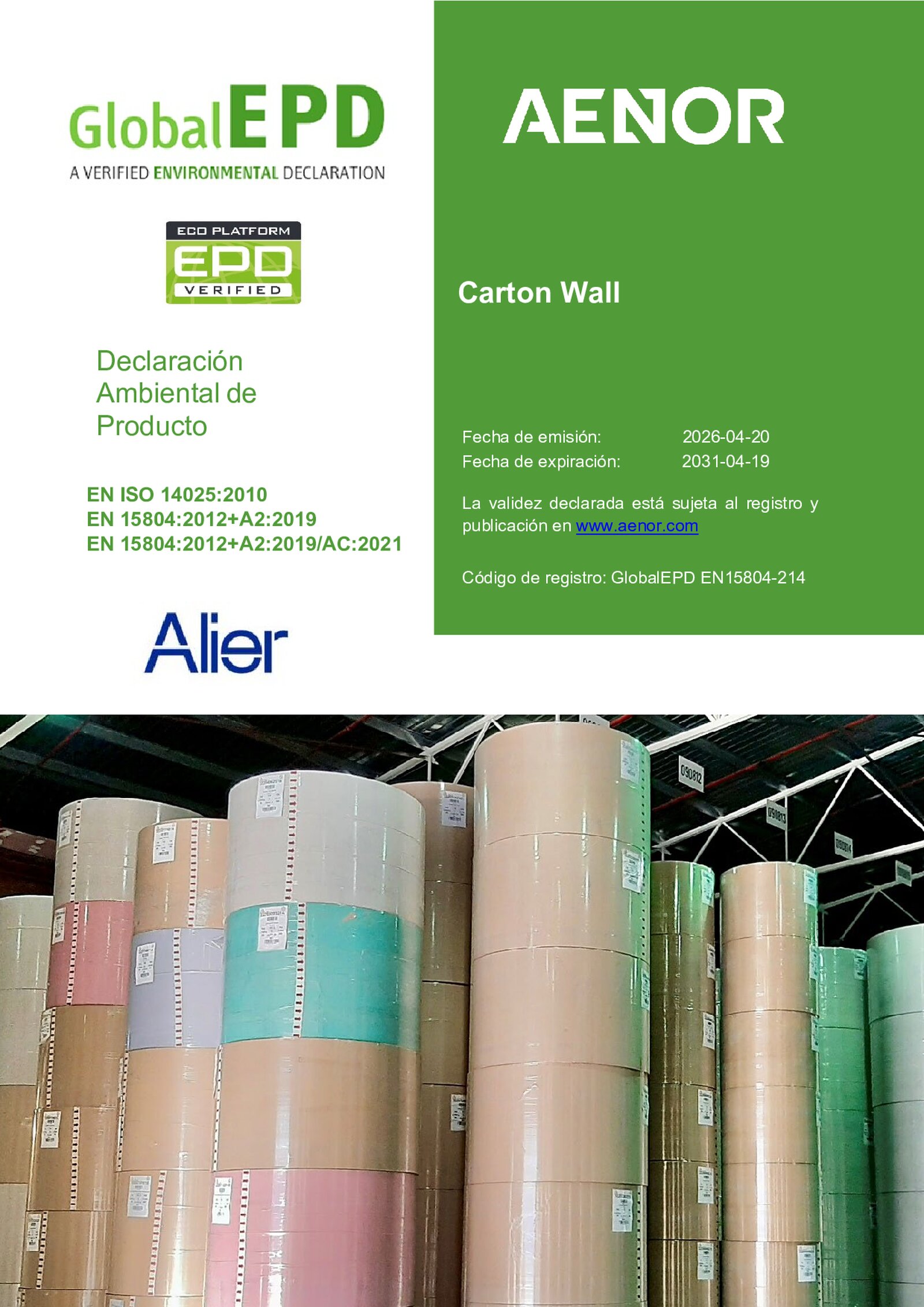
| ALIER integrates ecodesign and life cycle analysis as key tools to improve the environmental performance of its products, strengthen the traceability of the impacts associated with their life cycle, and offer its customers objective and verifiable environmental information. One of the company's significant milestones was the verification by AENOR, in 2022, of the Environmental Product Declaration —EPD/DAP— for the product Carton-Wall, under the reference GlobalEPD EN15804-028 rev1. This declaration made it possible to know more precisely the environmental impacts of the product throughout its life cycle and to provide customers with environmental information on the impacts associated with the use of a 100 % recycled material. Subsequently, in December 2023, ALIER verified the corresponding Environmental Product Declarations through AENOR. Semi-extendable bags y Bags, with the aim of aligning and quantifying the environmental impact of its products with the company's circular strategy. During 2025, ALIER began the process of reviewing the Environmental Product Declarations corresponding to Carton-Wall y Bags, as well as the development of the first specific EPD for the PolyAl granules. These studies were completed after the close of the 2025 financial year and before the preparation of this report, so their results are already available and can be used as an updated basis to strengthen product environmental information, the traceability of life cycle impacts and communication with customers and other stakeholders. In the case of paper for sacks, its EPD was not reviewed during 2025 as no production of this product was recorded during that year. However, the existing declaration remains valid until 2028. From a product innovation standpoint, ALIER continues the development of paper PBL high performance, A more efficient paper for plasterboard allows customers to reduce their paper consumption by reducing its weight while maintaining the required technical specifications. This product helps reduce raw material consumption, energy consumption, waste generated during roll transfers, transportation and storage needs, paper inventory volume, and waste associated with the final product. Furthermore, the commissioning of the plastics plant in October 2024 and its operational consolidation during 2025 reinforce ALIER's position in the circular economy. This facility allows for the valorization of the polyethylene and aluminum fraction from the recycling of beverage cartons, transforming it into PolyAl granules. In this way, ALIER is moving towards the comprehensive valorization of the brik packaging, recovering both the fiber for the manufacture of recycled paper and the plastic-aluminum fraction for its reincorporation as raw material in new recycled products. During 2025, the company also made progress in integrating circularity as a criterion for monitoring its industrial performance, strengthening the traceability of material flows, the production of PolyAl granules and the availability of information to assess the evolution of its circularity indicators. ALIER also maintains collaborations with universities, technology centers and research entities, such as DBA —Center for Biotechnological and Agrofood Developments—, the University of Alicante and EURECAT, aimed at improving processes, developing new waste valorization solutions and applying technologies that allow reducing environmental impacts in the manufacture of paper and recycled products. |
||
| Design for the Circular Economy |
| Ref. GRI Standard: 301 | ||
| RAW MATERIALS. All raw or auxiliary materials acquired by ALIER come from recycling processes. |
||
| CONTAINERS. All the packaging used in ALIER products comes from recycled processes. |
||
| CONTAINERS. All the waste generated by ALIER packaging, after its use or disposal, can be recovered. |
||
| PACKAGING. Some of the packaging used for the logistics and distribution of ALIER products comes from recycled processes. |
||
| PACKAGING. All the waste generated by ALIER packaging, after its use or disposal, can be recovered. |
||
| WASTE. All waste that may be generated by ALIER products or services after use by the customer or consumer can be recovered or reused. |
||
| Emission recovery in processes |
| Less than 25% of the emissions generated in ALIER's processes are recovered for other processes. |
||
| Water recovery and use |
| Ref. GRI Standard: 303-1 | ||
| More than 50% of the wastewater generated in ALIER's processes is recovered for other processes. |
||
| Other Circular Economy improvements |
| Ref. VSME (CSRD-EU): B7.001 | ||
| In 2024, ALIER began analyzing its circular economy indicators using Ecomundis' RightSupply.net digital platform and the RightCircular® tool to assess the Material Circularity Index (MCI). This indicator summarizes the degree of recycling, recovery, and valorization of the organization's products and operations throughout their life cycle, differentiating between a local or organizational perspective (MCI) and a global perspective (MCI). The methodological development of the ICM is inspired by the Ellen MacArthur Foundation's principles of circularity and incorporates elements of the WBCSD's Circular Transition Indicators, ensuring its interoperability with the ISO 59020 and ISO 59040 series of standards. In this way, ALIER has a monitoring tool that allows for a structured evaluation of the evolution of its circular performance and strengthens year-on-year comparability. ALIER reports an improvement of two points in the ICML and one point in the ICMG, compared to the 2024 result, consolidating the integration of circularity as a criterion for monitoring its industrial performance and its corporate strategy. |
||
| RSs: 115 | ||
| Acquisition and production of renewable energy |
| Ref. GRI Standard: 302-1 | ||
| All of ALIER's energy consumption comes from renewable sources (90%->100%). |
||
| Origin of the renewable energy acquired or produced |
| Biogas recovered from the wastewater treatment plant. Own production | ||
| ATLAS ENERGÍA with 100% of renewable (2023) Acquired marketer | ||
| Photovoltaics: Self-production | ||
RSs: 90
| Product and service life cycle analysis |
| ALIER communicates the results of the LCA through a certified environmental product declaration (EPD/EPD). |
||
| References and validated impact categories | ||
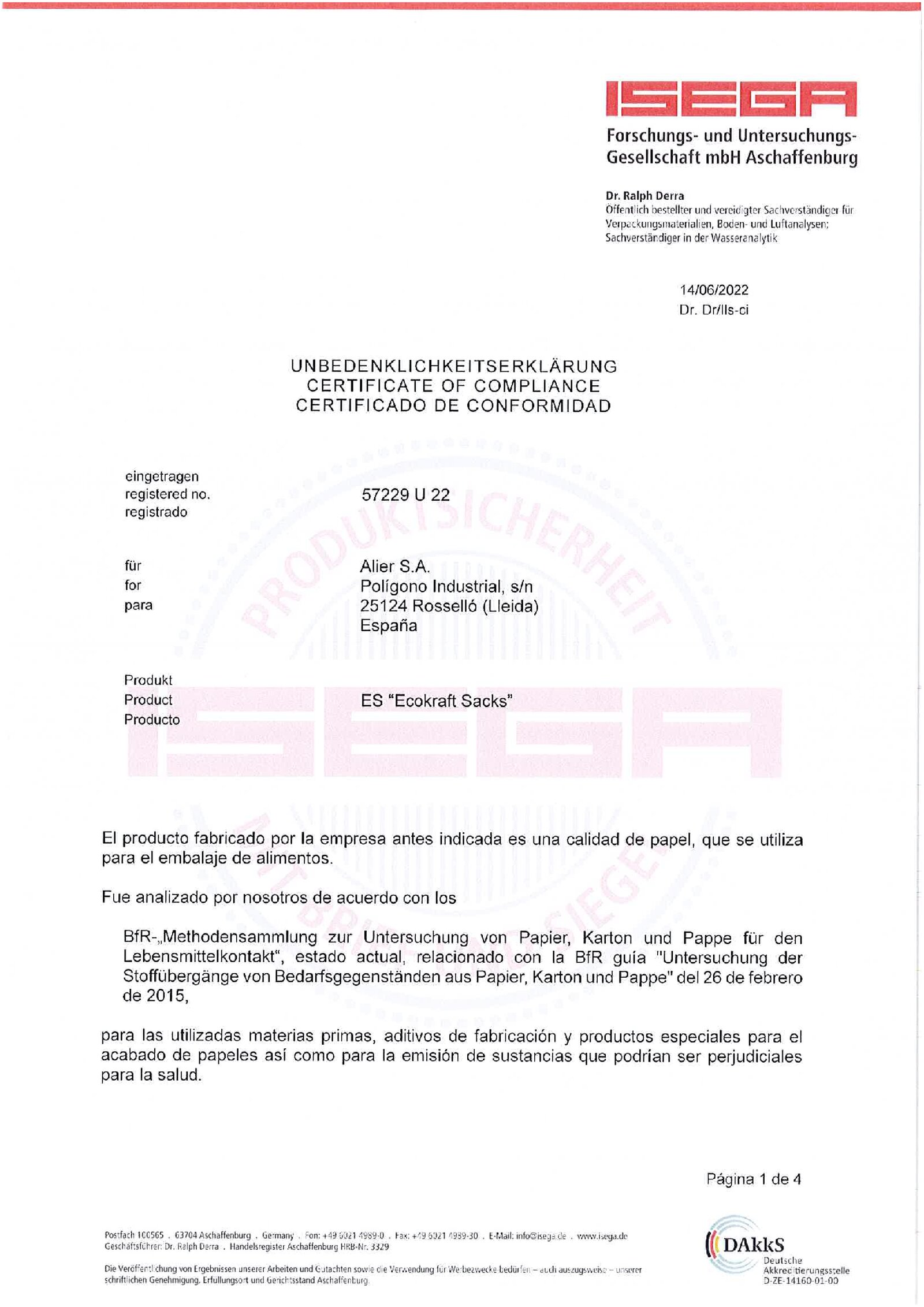
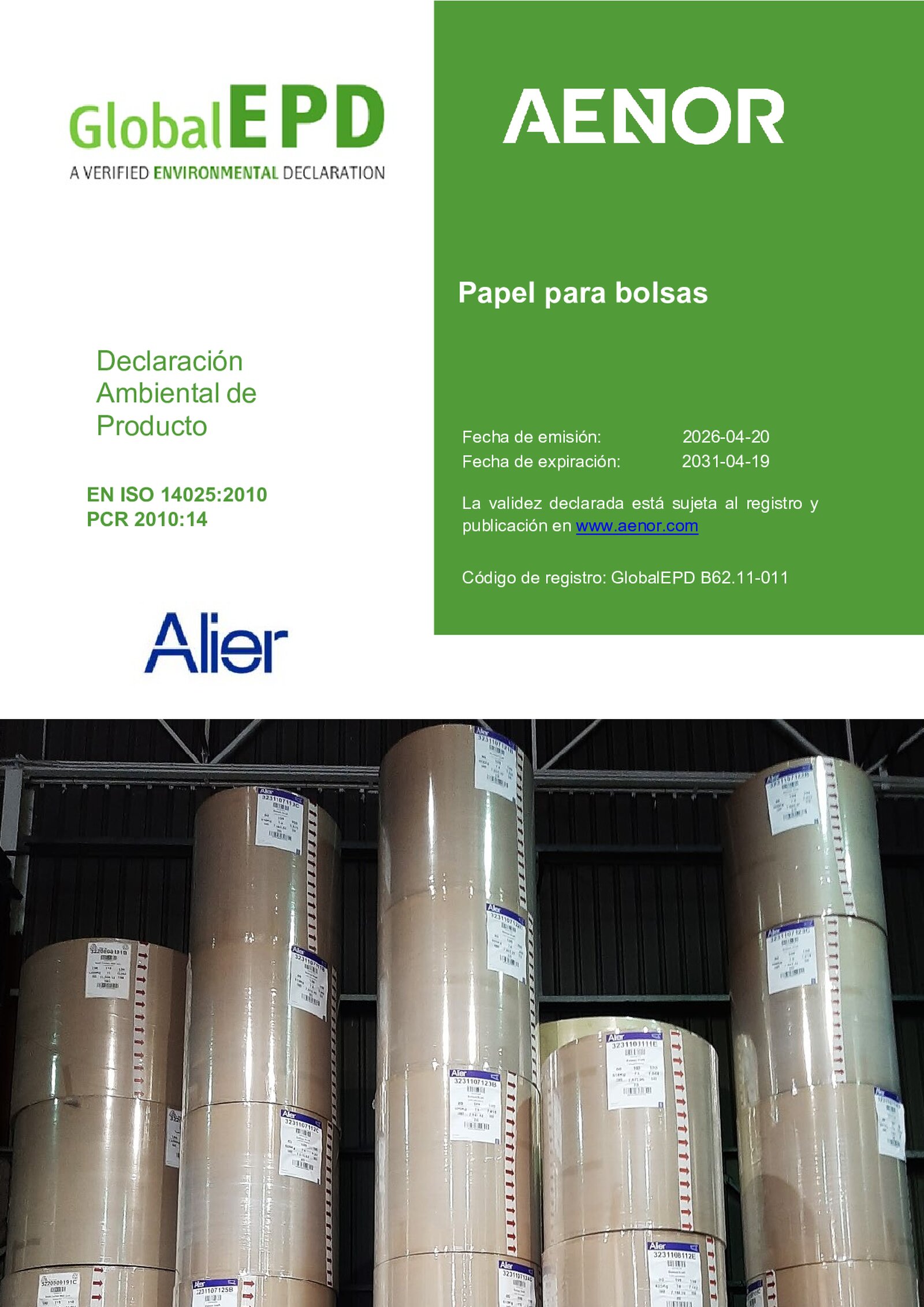
| CARTON WALL – EN ISO 14025:2010 EN 15804:2012+A2:2020 AENOR 22/08/2022 (See attached report (2022-08-22)) PAPER FOR BAGS – EN ISO 14025:2010 - AENOR 12/22/2023 () PAPER FOR SEMI-EXTENSIBLE BAGS – EN ISO 14025:2010 - AENOR 02/22/2023 () |
||
| RSs: 15 | ||
| Carbon footprint of products and organization |
| Ref. VSME (CSRD-EU): B3.003 , B3.004 , C3.014 – GRI Standard: 305 | ||
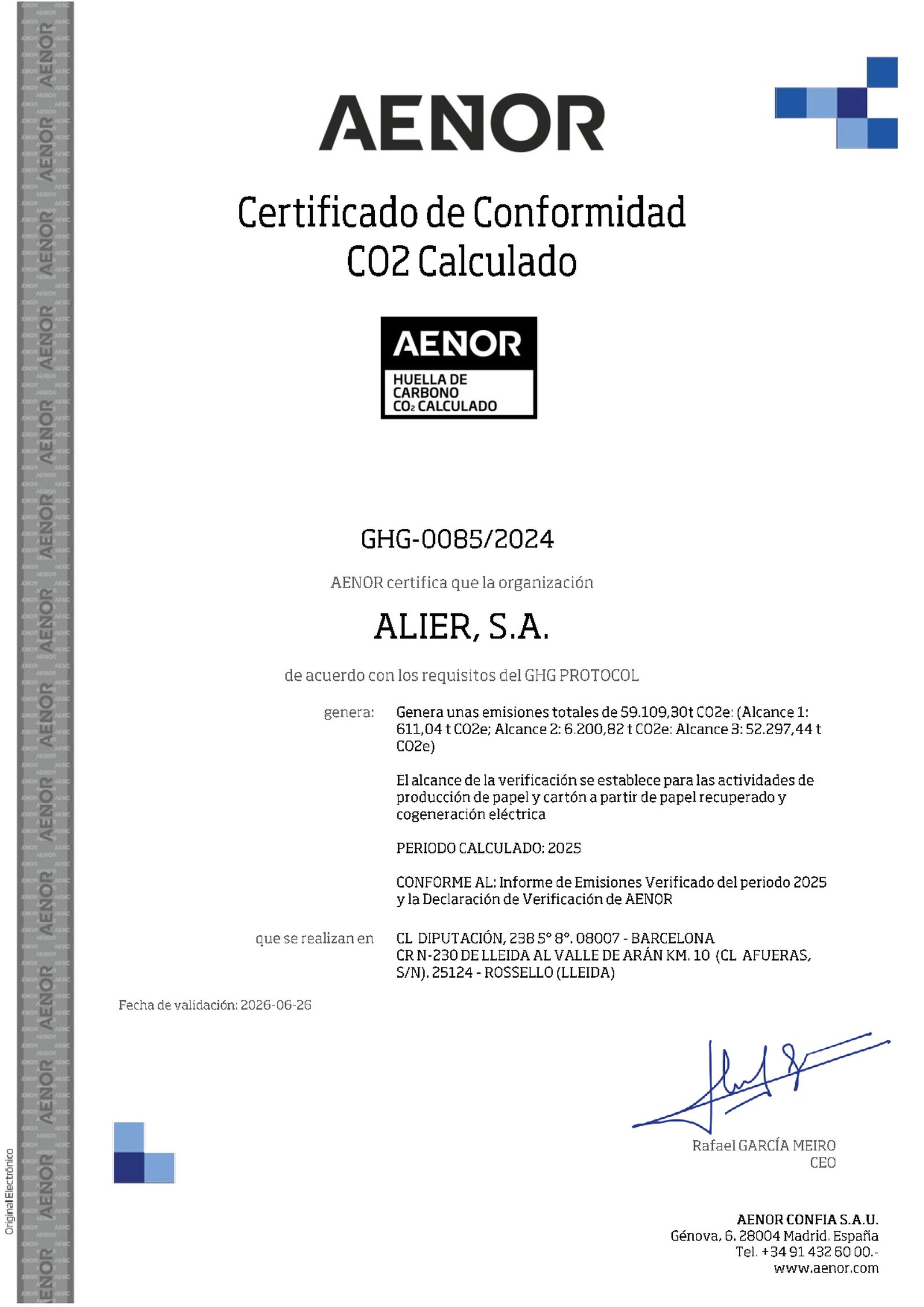
| ALIER has the carbon footprint calculation for some of its products or services, or for its organization, certified by an independent body. |
||
| Carbon Footprints by Products/Services | Scope type | Unit value | Calculation methodology | ||
| Organizational Carbon Footprints | Scope type | Unit value | Calculation methodology | ||
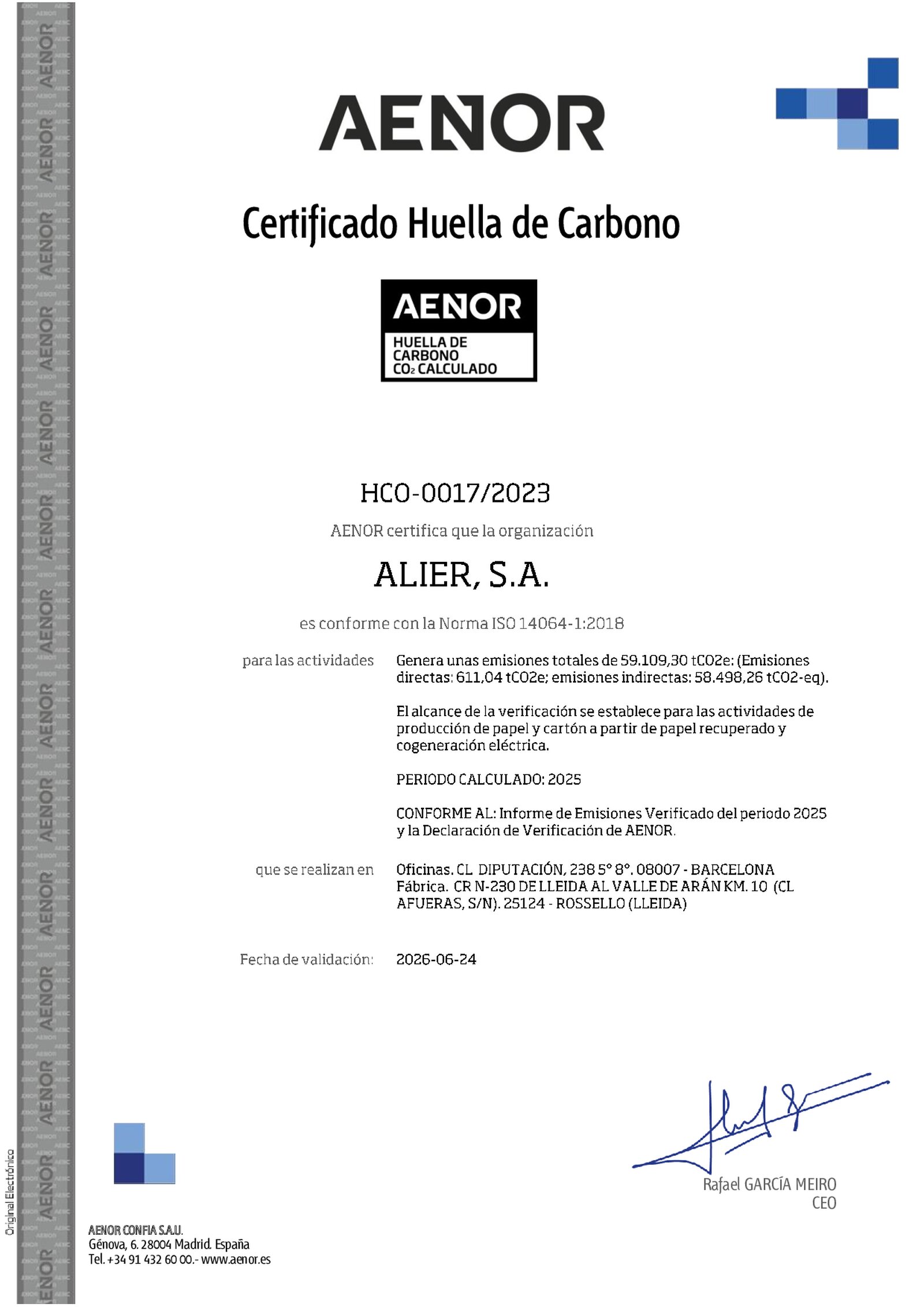
| Production/Offices – 59,109.3 t (Scope 1,2,3) |
||
| RSs: 15 | ||
| Description of the assessed CO2eq emissions inventory |
|
||
| Water Footprint |
| Ref. GRI Standard: 303-1 | ||
| ALIER does not have, nor does it plan in the short term to carry out, the calculation of its Water Footprint for any of its products, services or for its organization. |
||
| Water Footprints by Products/Services | Unit value | Calculation methodology | ||
| Water Footprints of Organizations by Products/Services | Unit value | Calculation methodology | ||
| RSs: 0 | ||
| Sustainability or Corporate Social Responsibility Reports |
| Report: | ||
| ALIER communicates its environmental performance externally through the preparation and publication of official reports or statements. |
||
| Website or link to the Sustainability Report, if available: Link | ||
| RSs: 40 | ||
| ALIER uses the Right Supply platform to assess its Sustainability Index. |
||
| RSs: 100 | ||
NOT YET. Item evaluated, not accredited or not available.
![]() |
The organization does not have the required documentation or does not possess the element or aspect being evaluated, recognizing this as a weakness or potential threat. In the context of ISO 9001, ISO 14001, or ISO 45001 Management Systems, this could represent a risk or an opportunity for improvement that the organization must plan for. |
GOOD. A suitable element or aspect that demonstrates correctness.
| The organization indicates that it sufficiently satisfies the evaluated element or aspect, providing information that demonstrates this. |
BETTER. Satisfactory element or aspect
| The organization indicates that it is favorably satisfied with the evaluated element or aspect, providing data that proves the good practices applied. |
BEST. Featured item or aspect
| The organization excels and satisfies in an excellent way with the element or aspect evaluated, providing data that proves the good practices applied. This rating requires validation by the audit services of Ecomundis · RightSupply after a review process of the information provided by the organization. |
GREAT. An excellent, innovative, or influential element or aspect.
| The organization excels and satisfies in an excellent way with the element or aspect evaluated, providing data that proves the good practices applied. Additionally, the organization extends the application of the good practice to its stakeholders in the value and supply chain, thus multiplying the sustainability effect, or its actions and behaviors are unprecedented and innovative. This rating can only be distinguished by the auditing services of Ecomundis · RightSupply after a review process of the information provided by the organization, except for those aspects that have official certifications considered to demonstrate excellence. |
| Environmental indicators |
| Waste generation | Ref. VSME (CSRD-EU): B7.002 to B7.005 |
![]() |
TOTAL WASTE GENERATION (Tons/t) | ||
| 2025 |
0,83 t/t | ||
![]() |
FRACTION OF WASTE MANAGED AS A BY-PRODUCT | |
| 2025 |
0 % |
|
![]() |
RECOVERED WASTE FRACTION | |
| 2025 |
76,64 % |
|
![]() |
INCINERATED WASTE FRACTION: | |
| 2025 |
0 % |
|
![]() |
FRACTION OF WASTE TO LANDFILL | |
| 2025 |
23,36 % |
|
![]() |
PACKAGING USAGE COEFFICIENT (KR/KP) | ||
| 2025 |
0,0008 KR/kp | ||
| Energy consumption | Ref. VSME (CSRD-EU): B3.001, B3.002 |
![]() |
TOTAL ENERGY CONSUMPTION (ELECTRICITY, NG, LPG…)/t) | |
| 2025 |
2,14 MWh/t |
|
![]() |
RENEWABLE ENERGY PRODUCED (MWh) | |
| 2025 |
9.478 MWh |
|
![]() |
% RENEWABLE ENERGY CONSUMED (as a percentage of the total) | |
| 2025 |
99,1 % |
|
| CO emissions2 | Ref. VSME (CSRD-EU): B3.003, B3.004, C3.015, C3.016, C3.017 |
![]() |
TOTAL CO2 EMISSIONS (SCOPE 1+2) | |
| 2025 |
6.812 t |
|
![]() |
TOTAL CO2 EMISSIONS (SCOPE 1+2+3) | ||
| 2025 |
59.109,3 t | ||
![]() |
OFFSET EMISSIONS | ||
| 2025 |
0 t | ||
| Water consumption and wastewater | Ref. VSME (CSRD-EU): B6.001 |
![]() |
TOTAL WATER CONSUMPTION (m3/t) | ||
| 2025 |
0,91 m3/t | ||
![]() |
INDUSTRIAL DISCHARGES (m3/t) | ||
| 2025 |
11,22 m3/t | ||
| Circular economy data. Materials of origin | UPstream |
![]() |
COMPOSITION IN HAZARDOUS SUBSTANCES | ||
| 2025 |
6,5 % | ||
![]() |
COMPOSITION IN RECYCLED RAW MATERIALS (%) | ||
| 2025 |
93,5 % | ||
| Circular economy data. Finished product. | DOWNstream |
![]() |
PRODUCT RECYCLABILITY (%) | ||
| 2025 |
100 % | ||
| Green taxonomy. Eligibility and alignment. |
| Eligibility and taxonomic alignment |
Circular Economy Metrics
Representation of the circularity of matter RightCircular©
He RightSupply Material Circularity Index (MCI) It summarizes the degree of recycling, recovery, and valorization of an organization's products and operations throughout its entire life cycle. Developed by Echomundis, the ICM RightCircular© It facilitates an annual calculation, expressing its magnitude as a percentage of corporate circularity under two different life cycle perspectives (ICM-Local and ICM-Global), in a practical way and aligned with Circular Transition Indicators proposed by the World Business Council for Sustainable Development (WBCSD) and the ISO 59020 standard.
-
ICML LOCAL OR ORGANIZATIONAL
INNER CIRCLE. It represents the level of circularity associated with the products or processes directly managed by the organization. It considers waste recovery and the maximum potential for recycling or reuse of the materials involved, incorporating the expected recovery efficiencies according to the nature of the product supplied. -
ICMG GLOBAL
OUTER CIRCLE. It measures the overall circularity of materials throughout the entire product lifecycle, from the origin of raw materials to their final destination after use. This index is the closest to the MCI proposed by the Ellen MacArthur Foundation.
-
CIRCULARITY SCALE
It represents the different levels of circularity achieved by an activity or organization in its ICM IndexL LOCAL.
🟧 IN CIRCULAR TRANSITION [21–40%] Reuse/recycling has begun, but it's still linear.
🟨 PARTIAL CIRCULARITY [41–60%] Moderate use of recycled materials and durable designs.
🟩 AVERAGE CIRCULARITY [61–80%] Greater reuse, repair and closed cycles.
🟦 HIGH CIRCULARITY [81–90%] Almost closed systems with minimal loss of resources.
🟪 DEMATERIALIZATION [>91%] Dematerialized or highly circular systems.

RightCircular PROGRAM: Voluntary membership program for companies that wish to evaluate the circular economy index of their activity under technical and objective criteria following internationally recognized norms and standards. Tel. +34 93 7777 623 – validation@rightsupply.net
CIRCULARITY INDEX
OF THE MATTER
2025
Manufacturing, recycling and valorization of paper from recovered materials.
MCI by Ecomundis – RightSupply™
Representation of partial circularity indices RightCircularTM Inner circle: % of Partial Circularity Ci. Outer circle: Ci x Circular efficiency of the system

RAW MATERIALS
- ALL SUBJECTS · Mi=165,993,860 t · Ci=93.5% · Ei=93.5%
DESCRIPTION: SECONDARY MATERIALS: Packaging waste, paper and cardboard from the selective collection of municipal solid waste and other materials from post-consumer recycling.
RENEWABLE ENERGIES
- ALL CONSUMPTION · Ci=94.8% · Ei=94.8%
DESCRIPTION: ENERGY: Biomass, Electricity, Diesel, Natural Gas, Biogas

RECIRCULATED WATER
- ALL CONSUMPTION · Ci=76.0% · Ei=76.0%
DESCRIPTION: RECLAIMED WATER: Alier's main water usage comes from two distinct sources. 99.65% is from the Pinyana Canal intake, and the remaining 0.35% is from the public water supply network.
WASTE GENERATED
- ALL WASTE · Mi=63,788,600 t · Ci=76.6% · Ei=62.7%
RRV Rates: SECTORAL
DESCRIPTION: Waste of potentially recyclable materials. Stock of PolyAl packaging scraps for processing at our own processing plant.

PRODUCTS AND SERVICES
- Paper for Cardboard Wall · Mi=86,513,284 t · Ci=100.0% · Ei=5.0%
RRV Rates: SECTORAL•EXPECTED HALF-LIFE: 60 years•ACTUAL HALF-LIFE: 45 years old•COMPARATIVE LONGEVITY: Comparable to that of the sector•COMPARATIVE USABILITY: Comparable to that of the sector
DESCRIPTION: UPCYCLING: Paper for Cardboard Wall - Paper for Bags · Mi=14,167,973 t · Ci=100.0% · Ei=90.0%
RRV Rates: SECTORAL•EXPECTED HALF-LIFE: 2 years•ACTUAL HALF-LIFE: 1 year•COMPARATIVE LONGEVITY: Comparable to that of the sector•COMPARATIVE USABILITY: Comparable to that of the sector
DESCRIPTION: UPCYCLING: Paper for Bags - PolyAl Granules · Mi=1,524,000 t · Ci=100.0% · Ei=100.0%
RRV Rates: SECTORAL•EXPECTED HALF-LIFE: 60 years•ACTUAL HALF-LIFE: 45 years old•COMPARATIVE LONGEVITY: Comparable to that of the sector•COMPARATIVE USABILITY: Comparable to that of the sector
DESCRIPTION: UPCYCLING: PolyAl Granules

CONTAINERS AND PACKAGING
- ALL CONTAINERS · Mi=645,709 t · Ci=58.9% · Ei=33.1%
RRV Rates: SECTORAL

PERFORMANCE: LONGEVITY & UTILITY
- ALIER VS SECTOR · Mi=1,000 t · Ci=100.0% · Ei=100.0%
HALF-LIFE
**EXPECTED POTENTIAL HALF LIFE**: Maximum period of time in years, in which the purpose and usability of the product remains viable before reaching its maximum intrinsic obsolescence.
**ACTUAL AVERAGE LIFE**: Period of time in years, based on statistical information, during which the consumer or user uses the product before disposing of it as waste.
INTENSITY OF THE MATTER OF THE ORGANIZATION
RightCircularTM It is a tool that facilitates the calculation and recording of the standardized circularity indicators proposed by the standards ISO 59020 e ISO 59040. It is aligned with the WBCSD Global Circularity Protocol for Business (World Business Council for Sustainable Development) and its scheme Circular Transition Indicators.
⚪ RSs: 45
| List of fundamental subjects in which the organization works |
Ref. VSME (CSRD-EU): S-C7.001 to S-C7.007 – GRI Standard: 408, 409
Our organization is committed to or acts in the following areas:
| PROTECTION OF HUMAN RIGHTS |
| ALIER does not sign agreements or contracts with human rights protection clauses or subject to human rights evaluation. |
||
| Ref. GRI Standard: 412-3.a | ||
| IMPACT ON COMMUNITIES |
| ALIER does not carry out operations with known significant negative impacts (actual or potential) that affect human rights. | ||
| Ref. GRI Standard: 413-2.a | ||
| SUPPLIER EVALUATION AND HUMAN RIGHTS |
| ALIER does not audit suppliers from countries at risk of human rights violations. |
||
…………………. |
NUMBER OF SUPPLIERS IN WHOSE COUNTRIES HUMAN RIGHTS ARE VIOLATED | ||
| 2025 |
0 | ||
REFERENCES
Specifically relating to the violation of rights and freedom of collective association, forced and child labor.
| References |
| Ref. GRI Standard: 407, 408, 409 |
| OUTSTANDING PRACTICES |
| Ref. VSME (CSRD-EU): C7.006 | |
ALIER articulates its commitment to the protection of Human Rights through its Code of Ethics, its people policies, its Welfare Policy, its compliance mechanisms, and its procurement, supplier approval, and evaluation procedures. This approach is integrated into the company's day-to-day management through internal communication of standards and expectations of conduct, onboarding and policy adherence processes, supply chain controls, and internal channels for consultation, communication, and reporting. With regard to its employees, ALIER expressly protects freedom of association and collective bargaining, the right to equal treatment and non-discrimination on the grounds of sex, ethnicity, religion, religious beliefs, sexual orientation or gender identity, including LGBTQ+ rights, as well as social protection for employees and adequate working conditions. The company expressly rejects illegal recruitment, child labor, forced labor, and any form of human trafficking, exploitation, or servitude, whether direct or indirect, within the organization or its value chain. ALIER's Welfare Policy reinforces these commitments through principles relating to respect for freedom of association, the prohibition of forced labor, the prohibition of child labor, non-discrimination in employment and the promotion of working conditions that respect fundamental rights, health, safety and the dignity of individuals. ALIER also maintains its adherence to the United Nations Global Compact, reinforcing its commitment to aligning its strategy and operations with international principles relating to human rights, labor standards, the environment, and the fight against corruption. This framework complements the Code of Ethics and consolidates a preventive approach to potential human rights violations within its operational sphere and in its relationships with third parties. In its relationships with suppliers, clients, and external collaborators, ALIER acts with transparency and integrity, avoiding any form of complicity with organizations that may violate human rights. The company promotes the principles set forth in its Code of Ethics and demands compliance with applicable regulations regarding environmental, labor, health and safety, and human rights. In the value chain, these commitments are progressively integrated into supplier approval and evaluation procedures. Through these mechanisms, ALIER can incorporate criteria related to regulatory compliance, occupational health and safety, respect for human rights, environmental management, and corporate social responsibility. Likewise, the Supplier Code of Conduct establishes the expected principles in business relationships and helps extend the company's ethical and social commitments to its supply chain. During fiscal year 2025, no confirmed complaints related to human rights violations were registered through established internal channels, including the Ethics Hotline and human resources management mechanisms. Furthermore, based on supplier approval and evaluation procedures and available information, no suppliers were identified as posing a significant risk in relation to child labor, forced labor, or obstacles to freedom of association and collective bargaining. |
RSs: 28
Ref. GRI Standard: 403
Our organization is committed to or acts in the following areas:
Work and labor relations| GENDER EQUALITY IN TREATMENT AND OPPORTUNITIES |
| Ref. VSME (CSRD-EU): C5.001 -. GRI Standard: 405 | ||
| |
ALIER reports its management of gender equality in a verified manner. |
DOCUMENT:EQUALITY PLAN INTRO
We promote equal pay for women and men ………………….. |
WOMEN WORKERS: WAGE DIFFERENCE BETWEEN MEN AND WOMEN (%) | ||
| 2025 |
12,2 | ||
………………….. |
DIRECTIVES: SALARY DIFFERENCE BETWEEN MEN AND WOMEN (%) | ||
| 2025 |
8,2 | ||
| OCCUPATIONAL SAFETY AND HEALTH AND PREVENTION OF OCCUPATIONAL RISKS |
| Ref. VSME (CSRD-EU):-C6.008 – GRI Standard: 403, 416 | |
| Our organization monitors and acts in the following areas of occupational safety and health: | |
| 01. HAS RESOURCES AND PERSONNEL DEDICATED TO OCCUPATIONAL SAFETY AND HEALTH We have a designated worker for Occupational Health and Safety, We have prevention delegates among the workers, No staff with exclusive functions in matters of Occupational Health and Safety, Our own team or service for the prevention of occupational risks, External or subcontracted prevention service. 02. HAS ACCIDENT PREVENTION PROCEDURES IN PLACE IN: Special work (at heights, confined spaces, electrical work, explosive atmospheres, etc.), Delivery and renewal of Personal Protective Equipment, Safe tools and equipment, Safe machinery and instruments under certification. i.e.: CE (EU)/NFPA®/NEC CODES (USA) markings..., Safe storage and transport of loads, Correct safety and emergency signage, Fire prevention assured, Preventive maintenance for the safety of the facilities, Existence of Preventive Guidelines, Existence of Prevention Plans, Safe workplace and work surfaces. 03. HAS INDUSTRIAL HYGIENE PROCEDURES IN PLACE IN: Prevention and safety against physical agents, Prevention and safety against chemical agents. 04. HAS ERGONOMIC PROCEDURES IN THE WORKPLACE IN: Adaptation of the workstation. 05. PERFORMS ACTIONS RELATED TO MEDICINE AND HEALTH AT WORK IN: Health Promotion, Health Surveillance. 06. HAS PROCEDURES IN PSYCHOSOCIOLOGY AND WORKER WELL-BEING IN: Participation and supervision. 07. APPLY THE COORDINATION OF BUSINESS ACTIVITIES IN: Systematic approach to ensuring the prevention of risks for contractors. 08. REGARDING COMMUNICATION AND PARTICIPATION OF WORKERS Workers have access to safe ethical channels, a Health and Safety Committee is in place, workers receive initial and periodic training on the risks associated with their job, workers participate in risk assessments, workers have free access to preventive health check-ups, and workers participate in preventive planning. 09. PLANNING OF PREVENTIVE ACTIVITY We have a system for the evaluation and compliance with legal requirements. All jobs have documented preventive guidelines. All risk tasks and processes have documented preventive guidelines. Our organization conducts occupational risk prevention audits annually. 10. EMERGENCY RESPONSE Updated Emergency Plans are available for the facilities and centers, and emergency drills are carried out. |
| WORK ACCIDENT RATE |
| Ref. VSME (CSRD-EU):-B9.001,B9.002 – GRI Standard: 403 | |||
………………….. |
ACCIDENT FREQUENCY RATE (Number of accidents resulting in sick leave per million hours worked) Illness or injury arising out of and in the course of employment. |
||
| 2025 |
15,46 |
||
………………….. |
ACCIDENT SEVERITY INDEX (Number of days) work-related/sick leave – per thousand hours worked) Illness or injury arising out of and in the course of employment. |
||
| 2025 |
0,37 |
||
| TRAINING FOR WORKERS |
| Ref. VSME (CSRD-EU):-B10.004, B10.005– GRI Standard: 404-1 a |
| AVERAGE TRAINING HOURS PER EMPLOYEE PER YEAR | |||
| 2025 |
27,8 h/e. | ||
| JOB STABILITY FOR WORKERS |
| Ref. VSME (CSRD-EU):-B8.001 to B8.005 – GRI Standard: 102-8 |
…………………. |
PERCENTAGE OF INDEFINITE OR PERMANENT CONTRACTS | ||
| 2025 |
100 %. |
||
| SOCIAL BENEFITS |
| Ref. GRI Standard: 401-2.a | |
| EMPLOYMENT BENEFITS Flexible working hours. |
| OUTSTANDING PRACTICES |
| Ref. VSME (CSRD-EU): B2.001, B2.002, B2.004, C2.001 | |
Sustainable labor practices ALIER develops its labor practices from an approach focused on regulatory compliance, job stability, collective bargaining, the participation of the legal representation of workers and continuous improvement in safety and health, equality, work-life balance and professional development. At the close of fiscal year 2025, the Group has a workforce of 313 people, 299 of whom work for ALIER, SA, the Group's parent company and main operating and industrial center. Almost all employees are covered by a collective bargaining agreement, and labor management is structured through internal policies, human resources procedures, and mechanisms for participation and consultation with the legal representatives of the workers. In the area of occupational health and safety, ALIER has an internal Occupational Risk Prevention Department, staffed by four people, with support from an external prevention service. This structure allows for specialized preventative management, integrated into industrial operations and aligned with the corporate strategy. During 2025, the preventative system was strengthened through the updating of the Self-Protection Plan, the execution of an emergency drill, the implementation of FACT24 as an emergency management and communication tool, and the consolidation of NEXT PRL as a comprehensive preventative management platform. This tool provides employees with access to job information, online training, PPE and workwear management, health monitoring, and risk communication. The company also maintains a schedule of medical check-ups so that all workers can access health monitoring with the established frequency according to their job position, which is annual for factory positions. In the area of training, ALIER develops an annual training plan tailored to the needs of each department and the company's operational, technical, and organizational challenges. In 2025, 8,309 hours of training were delivered, compared to 8,194 hours in 2024, reinforcing topics related to prevention, technical skills, digitalization, leadership, team management, and transferable skills. This training effort contributes to improving the versatility, safety, operational efficiency, and professional development of the workforce. During 2025, ALIER also reinforced its commitment to equality and diversity by signing its second Equality Plan, valid until 2028. This plan incorporates objectives and actions in areas such as communication, participation, leadership, recruitment, promotion, equal pay, leave, prevention of violence and harassment, health and safety, supply chain, social responsibility, and LGBTQ+ diversity. Furthermore, during the year, training on unconscious bias, previously provided to managers, was extended to all employees. The company promotes work-life balance through measures such as flexible hours, teleworking where the position allows, leave stipulated in the collective bargaining agreement, reduced working hours, and other work organization measures. In addition, it offers benefits and flexible compensation programs focused on well-being and work-life balance. In addition to its labor policies, ALIER has its own social club, Club Alier, which encourages employee participation in social, recreational, cultural, and sporting activities, as well as initiatives promoting healthy habits. Highlights of 2025 include activities such as discounts on gym memberships, padel tournaments, cultural events like Sant Jordi Sostenible and La Castanyada, and ALIER's membership in the Spanish Association Against Cancer as an Oncoadherent Company, which includes awareness campaigns for employees. |
RSs: 125
Ref. GRI Standard: 304, 305, 306, 308
Our organization is committed to or acts in the following areas:
Pollution prevention| OUTSTANDING PRACTICES |
| Ref. VSME (CSRD-EU): B2.001, B2.002, B2.004, C2.001 See the indicators integrated into the section “Environmental Sustainability” |
|
It is worth mentioning that there are outstanding environmental projects such as:
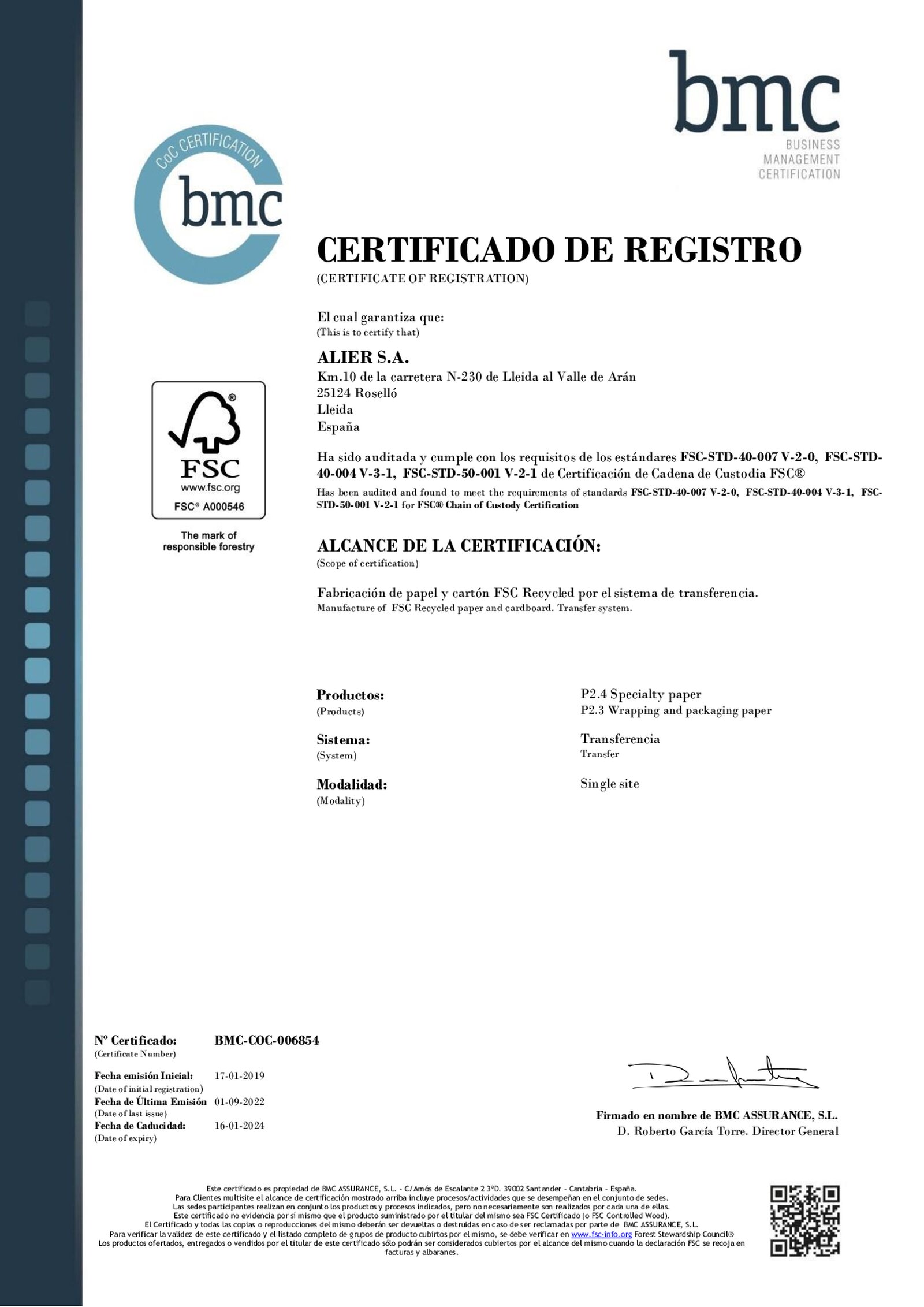
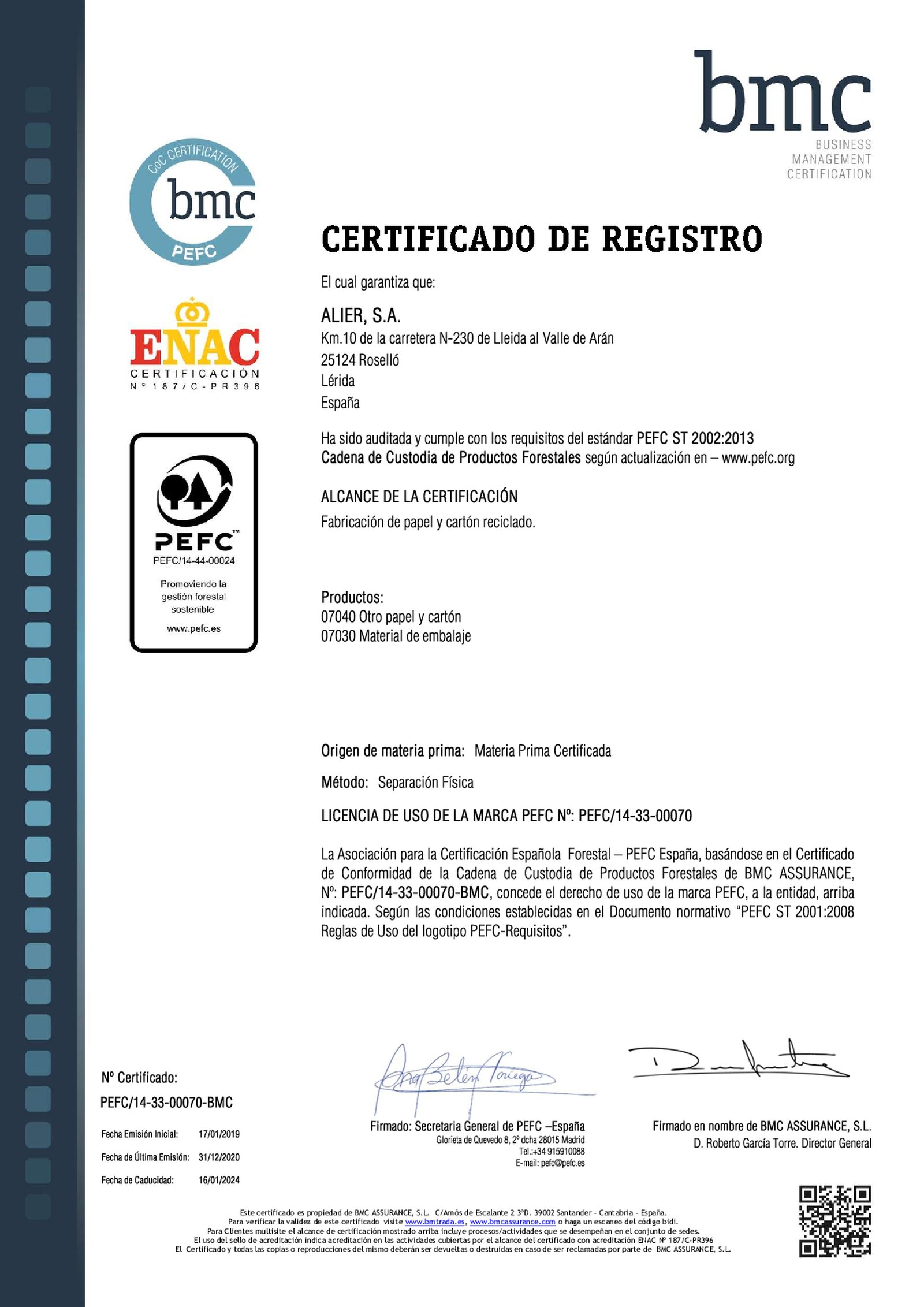
ALIER, SA has an Environmental Management System certified according to the UNE-EN ISO 14001:2015 standard and aligned with the EMAS scheme, through which it integrates the identification and evaluation of environmental aspects, legal compliance, impact prevention and continuous improvement of environmental performance. The company's main environmental objectives are geared towards optimizing the rational and efficient use of the natural resources needed to develop its activity, reducing the environmental impacts of direct activities, minimizing the environmental impact associated with the life cycle of products and incorporating the best available pollution prevention techniques that are technically and economically viable. ALIER's environmental commitment is realized daily through industrial activity based on waste valorization and the manufacture of products from recovered raw materials. The company does not use virgin fiber in the manufacture of its paper products, thus ensuring the circularity of the paper value chain and contributing to reducing pressure on forest resources. This approach is reinforced by FSC 100 % Recycled and PEFC 100 % certified chain of custody certifications. During 2025, ALIER made progress in consolidating its circular economy model through the plastics recycling plant commissioned in October 2024. This facility allows for the recovery of the polyethylene and aluminum fraction from recycled beverage cartons, transforming it into PolyAl granules. In this way, ALIER strengthens the comprehensive recovery of beverage cartons, recovering both the fiber for recycled paper and the plastic-aluminum fraction for reincorporation as raw materials in new recycled products. In terms of circularity, the company has continued working on the traceability of material flows, the production of PolyAl granules, and the availability of information to evaluate its circularity indicators. Within this framework, ALIER reports a two-point improvement in the Local Material Circularity Index (LMCI) and a one-point improvement in the Global Material Circularity Index (GMCI), consolidating circularity as a criterion for monitoring industrial performance. Regarding waste, ALIER recovered more than 81.% of the waste generated in 2025, compared to 71.% recorded in 2024. This improvement is part of the company's circular economy strategy and the progressive consolidation of solutions for the treatment, recovery, and reintegration of materials into the production cycle. In the area of water, ALIER maintains projects focused on recycling and reusing process water, as well as reducing freshwater intake at the source and improving discharge control. Water management is a priority environmental aspect due to its relationship with production activity, resource efficiency, and the protection of aquatic ecosystems. In the energy and climate sector, ENGIE's biomass plant will be fully operational by 2025, supplying biomass-derived steam to ALIER and reducing its reliance on fossil fuels for thermal power generation. The company is also maintaining its rooftop photovoltaic production, which began in 2023, and continuing to increase its use of renewable energy sources, including electricity with guarantees of origin. ALIER's decarbonization actions are structured around the reduction of Scope 1 and Scope 2 emissions, through the 35.9 MW biomass plant, 11.7 MW rooftop photovoltaic installations, 3.195 MW ground-mounted photovoltaic installation, optimization of facilities and equipment, and acquisition of electricity from renewable sources with Guarantees of Origin. During 2025, ALIER also secured public funding for strategic industrial decarbonization projects. These include the ALIER2ZERO project, focused on decarbonizing the industrial plant, and the GYPZERO project, aimed at implementing a new, highly decarbonized gypsum board production and recycling facility. Both projects reinforce the company's trajectory toward a more efficient, circular, and low-carbon industrial model. The progressive integration of the GYPZERO plant into the scope of the Integrated Management System is planned to begin in July 2026, including the implementation of procedures, the assessment of legal requirements, and its future incorporation into the audited and certified system. In terms of product information, ALIER has made progress in updating and expanding its verified environmental data by revising the Environmental Product Declarations (EPDs) for Carton-Wall and Bags, as well as developing the first EPD specifically for PolyAl granules. These declarations improve the traceability of environmental impacts throughout the product lifecycle and provide customers with objective information on the environmental performance of their products. The environmental objectives can be found in the verified Environmental Statement: https://www.valuechain.rightsupply.net/emas_statement/alier/#emas_objetivos |
RSs: 4
Ref. GRI Standard: 2-25, 205, 206
Our organization is committed to or acts in the following areas:
Anti-corruption| LOCAL HIRING |
| Percentage expressed in monetary economic value on the total contracting | ||
| |
More than 50% of the products and services acquired or contracted by ALIER are of foreign origin local or regional. |
|
| Ref. GRI Standard: 204-1.a |
| COMPETENCE PRACTICES |
| ALIER does NOT have any pending or convicted legal cases related to unfair competition or in which the organization has been involved. |
||
| Ref. GRI Standard: 206-1.a | ||
| FIGHT AGAINST CORRUPTION AND BRIBERY |
| ALIER successfully implements internal protocols for evaluating and controlling corruption. |
||
| Ref. GRI Standard: 205-3.a | ||
| MISSION AND/OR VALUES OF THE ORGANIZATION ASSOCIATED WITH GOOD GOVERNANCE |
| ALIER has formulated a mission and values that include good governance of the organization. |
||
| ANALYSIS OF STAKEHOLDER NEEDS AND EXPECTATIONS. Materiality (degree of interest and influence) |
| |
ALIER has formulated a materiality analysis to understand the aspects of greatest interest to stakeholders. |
|
| OUTSTANDING PRACTICES |
| Ref. VSME (CSRD-EU): B2.001, B2.002, B2.004, C2.001 |
|
ALIER develops its good governance practices based on a corporate culture founded on integrity, transparency, respect for people, respect for the environment, and continuous improvement. These principles are embodied in its corporate values: “People First,” “Respect for the Environment,” “Honest, Transparent, and Integrity,” and “Evolution as a Constant.”. During 2025, ALIER strengthened its sustainability governance model through the Sustainability Committee, supported by an operational monitoring team. This body translates the ESG strategy into action plans, monitors the Sustainability Master Plan, reviews key indicators, coordinates sustainability reporting, and ensures the traceability of those responsible and the evidence provided. The company maintains a framework of integrity and compliance based on its Code of Ethics, approved on October 24, 2024, and its Compliance Policies. These instruments are mandatory for all members of the organization and are formalized through employee adherence upon joining the company and whenever changes are made to the applicable internal framework. ALIER also has an Ethics Hotline that allows any employee, collaborator, or third party outside the organization to report potential legal or Compliance Policy breaches, as well as to ask questions about the interpretation or application of internal regulations. This hotline guarantees confidentiality, protection from retaliation, the possibility of anonymous communication, and the processing of data in accordance with data protection regulations. In 2025, one inquiry was received through the Ethics Hotline, which was reviewed and investigated, and subsequently closed as no evidence of a violation was found. Regarding the fight against corruption and money laundering, ALIER communicates its internal policies during the onboarding process, including the Anti-Corruption and Anti-Bribery Policy. These policies are sent to employees for review and signature via the Summar application, and a specific annual communication on anti-corruption is also issued. In the area of fair trade and the value chain, ALIER promotes responsible and sustainable behavior aligned with the principles of good corporate governance. The company communicates the principles outlined in its Code of Ethics to suppliers, customers, and external partners and requires compliance with applicable regulations regarding the environment, occupational health and safety, and respect for human rights. ALIER has a supplier approval and evaluation procedure, revised in 2023, that incorporates ESG criteria in both the approval phase and ongoing assessment. Since the implementation of ISO 14001, suppliers have been informed of the applicable environmental requirements, and since 2023, approved suppliers have been required to adhere to the Supplier Code of Conduct. The approval process considers aspects such as waste management, environmental management, and corporate social responsibility; and the ongoing assessment incorporates criteria such as transparency, environmental impact assessments of products, CSR policies, and sustainability certifications. |
RSs: 48
Ref. GRI Standard: 418
Our organization is committed to or acts in the following areas:
Fair marketing practices, objective and impartial information, and fair hiring practices| Proper attention to clients, consumers and users |
| ALIER has a system of attending to requests for information and complaints from its customers, consumers or users. |
||
| PRODUCT/SERVICE SAFETY |
| ALIER assesses the health and safety impacts associated with various categories of products or services, in order to introduce improvements to these. |
||
| Ref. GRI Standard: 416-1.a | ||
| ADVERTISING ETHICS AND DECEPTIVE ADVERTISING |
| ALIER complies with regulations and ethical codes related to its marketing communications, such as advertising, promotion, and sponsorship. 0 Non-compliances. |
||
| Ref. GRI Standard: 417-3.a | ||
| CUSTOMER AND USER PRIVACY |
| There are no substantiated claims regarding violations of customer/consumer privacy. |
||
| |
ALIER guarantees the protection of data and the privacy of its clients and consumers in relation to personal data and information or other confidentiality guarantees. |
|
| Ref. GRI Standard: 418-1.a | ||
| OUTSTANDING PRACTICES |
| Ref. VSME (CSRD-EU): B2.001, B2.002, B2.004, C2.001 |
|
ALIER develops its product safety and sustainability practices from a B2B perspective, as it does not market products intended for the end consumer. In this context, its commitments focus on product quality, conformity, and safety for its intended use in industrial processes, objective technical and commercial information, customer service and support, claims management, and the protection of technical and commercial information shared in customer relationships. The company has a system in place for handling information requests, technical support, and complaints within the framework of its ISO 9001:2015 Quality Management System. Incidents are received through the sales department and, when they affect product quality, are managed by the quality department through the complaints and nonconformities handling process. During 2025, no significant non-compliance was recorded regarding the health and safety impacts of product and service categories for their intended use in industrial processes. Furthermore, applicable product identification and labeling requirements were met where appropriate. ALIER also maintains the customer technical support service called Value Added Paper from Alier (VAPA), Focused on comprehensive technical assistance and advice, this service allows us to offer customized solutions to our clients, contribute to improving the efficiency of their processes, support the development of new products, resolve industrial issues, and optimize the use of ALIER products in their facilities. From a product sustainability perspective, ALIER continues to promote ecodesign, innovation, and life cycle analysis as tools to improve the environmental performance of its products. In 2025, the review process for the corresponding Environmental Product Declarations began. Carton-Wall y Bags, as well as the development of the first specific EPD for the PolyAl granules. These works allow us to strengthen the traceability of environmental impacts associated with the life cycle, improve environmental communication with customers and other stakeholders, and have verified information on products linked to ALIER's circular economy model. Product innovation remains a key pillar of the sustainability strategy. A prime example is paper. PBL high performance, Developed for gypsum boards, this product maintains strength performance while offering improvements such as energy savings, reduced waste during roll transitions, reduced transport and storage costs, decreased paper inventory, and less waste in the final product. These improvements contribute to more efficient use of raw materials and a reduced carbon footprint across the value chain. ALIER also collaborates with universities, technology centers, and other research institutions to develop solutions for waste valorization, process improvement, and the development of new products with reduced environmental impact. These collaborations strengthen the company's ability to translate technical innovation into tangible improvements in product safety, quality, circularity, and sustainability. |
RSs: 51
Ref. GRI Standard: 403
Our organization is committed to or acts in the following areas:
Education and culture| IMPACT ON THE LOCAL COMMUNITY |
| ALIER does not carry out operations or activities with known negative impacts (real or potential) on local communities. | ||
| Ref. GRI Standard: 413-2.a | ||
| PLANNING OF COOPERATION AND COMMUNITY DEVELOPMENT ACTIONS |
| ALIER carries out specific cooperation actions for community development based on specific needs. |
||
| Ref. GRI Standard: 413-1.a | ||
| RECIPIENTS OF THE AID OR COOPERATION PROVIDED |
| BENEFICIARY ORGANIZATIONS Universities, Cultural Institutions, Scientific Institutions, Sports Clubs. NEED OR EXPECTATION MET Help for vulnerable groups of people, help for groups of people with disabilities. CONTRACTING SERVICES FROM SOCIAL ENTERPRISES One-off service contract, Regular/annual service contract. PURCHASE OF PRODUCTS FROM SOCIAL ORGANIZATIONS Regular/annual purchase of products. COLLABORATION AGREEMENTS Advertising sponsorships. |
| COMMUNITY SUPPORT ACTIONS |
………………….. |
NUMBER OF PLANNED ACTIONS TO SUPPORT THE COMMUNITY OR SOCIAL INTEREST ENTITIES | ||
| 2025 |
7 | ||
| OUTSTANDING PRACTICES |
| Ref. VSME (CSRD-EU): B2.001, B2.002, B2.004, C2.001 – GRI Standard: 2-28, 2-29 | |
Academic and research entities Collaboration with universities, technology centers and educational programs is a strategic axis of ALIER's community development, aimed at promoting knowledge transfer between industry and academia, fostering the employability of young graduates and developing specialized talent in industrial sectors with a high technical component. Among the main initiatives, the following stands out: Master's Degree in Paper and Graphic Technology, Promoted by ASPAPEL in collaboration with the Polytechnic University of Catalonia, through the Terrassa School, ALIER was an active driving force behind the creation of this master's program, which covers a specialization previously unavailable in the Spanish university system. The collaboration includes scholarships covering 100% of tuition fees, 810 hours of work placement, financial support for studies, and the possibility of subsequent professional integration. ALIER also maintains an ongoing collaboration with University of Lleida, especially through the Dual Industrial Master's Degree in Industrial Engineering, the Dual Master's Degree in Occupational Risk Prevention and the hosting of students in curricular and extracurricular internships from different degrees. The company also collaborates with other university and technology centers, including IQS – Institut Químic de Sarrià, the University of Girona, the URV, UNIR, UIV, LABASAD and Eurecat, in areas related to chemical engineering, applied research, digitalization, communication, marketing and R&D projects linked to the circular economy. Additionally, ALIER promotes educational programs in secondary, primary and vocational training, among which the RCS program – “Research, Creation and Service” with the Joan Solà Institute of Torrefarrera, recycling and circular economy workshops in primary education centers and internships for Intermediate and Higher Level Vocational Training Cycles stand out. Cultural, sports, social and health entities ALIER maintains an active connection with local cultural, sporting, and social organizations through sponsorships, collaborations, and financial contributions. In the sporting arena, it collaborates with... Rosselló Football Club and the Club Esportiu Atlètic Lleida 2019, contributing to the promotion of grassroots sport, the encouragement of healthy habits and the social revitalization of the territory. In the cultural sphere, ALIER is a patron of the foundation of Molí Paperer Museum of Capellades, contributing to the preservation and dissemination of historical papermaking heritage. It also maintains its connection with the Association of Historical-Paper Studies, the entity responsible for the management of the museum, in whose board of directors ALIER participates through the Directorate of Growth and Sustainability. During the year, the company also made contributions to social and healthcare organizations such as the Foundation for Health and Sustainability, the Spanish Association Against Cancer and the Fragile X Syndrome Association. Social protection and labor integration actions ALIER remains committed to the employment integration of people with disabilities and to complying with the General Law on the Rights of Persons with Disabilities and their Social Inclusion. As an alternative to fulfilling the legal quota, the company collaborates with organizations and special employment centers that promote social and labor inclusion. In this regard, ALIER maintains its collaboration with Sant Joan de Déu Foundation, through the contracting of gardening services as an alternative measure of labor integration, and makes purchases of raw materials from TIRGI Gironès Special Employment Center. These collaborations contribute to generating inclusive employment opportunities and promoting a positive social impact in the company's operating environment. Likewise, collaboration with the Reintegra Foundation, through the CPO Dual Electricity program, strengthening the link between training, employability and social inclusion. Sectoral entities and representation ALIER actively participates in sectoral and business associations, contributing to industrial development, the circular economy, the energy transition and the representation of the paper and recycling sector. Among the main entities in which it participates are the Catalonia Waste Cluster, where he holds the presidency; ASPAPEL, as a member of the Board of Directors; the Cercle d'Economia, with representation on its Board of Directors; Foment del Treball Nacional; CEOE Aragón; he Bioenergy Cluster of Catalonia; he Efficient Energy Cluster of Catalonia; he Sectoral Cluster of Industrialized Construction of Catalonia; ANAIP, National Association of Plastics Manufacturers; and ANARPLA, National Association of Plastic Recyclers. This participation allows ALIER to strengthen its sectoral and institutional dialogue, contribute to the development of more sustainable industrial frameworks and maintain an active position in debates related to circular economy, decarbonization, industrial competitiveness, recycling and energy transition. |
RSs: 53
Notes on Governance and Transparency
- Promote CSR strategies and objectives,
- To make progress on commitment and accountability,
- Creating a CSR culture,
- Establish incentives to achieve positive performance in CSR,
- To make efficient use of resources,
- Improving opportunities for vulnerable groups (women, ethnic minorities, etc.) to occupy leadership positions,
- Addressing the needs of stakeholders and future generations,
- Improve communication with stakeholders,
- Encourage the participation of members of the organization in CSR activities,
- Conduct ongoing reviews of the organization's governance.
| Agenda 2030 and Sustainable Development Goals (SDGs) in action |
Our organization is familiar with the 2030 Agenda and its 17 Sustainable Development Goals (SDGs). This digital sustainability report includes a list of the SDGs that have the greatest impact on the life cycle of our products and activities, as well as the practices and actions aimed at advancing positive impacts on those we consider priorities. During 2023, Alier carried out the first mapping or localization of the Sustainable Development Goals of the 2030 Agenda on the RightSupply.net platform in its RS26000 digital report. This report includes a specific section for the SDGs, observing those that have the greatest influence on the life cycle phases of Alier's products and in an integrated way with the core subjects of the ISO 26000 standard.
| Objectives we are actively working on |

| Status of implementation of the 2030 Agenda |
| ALIER has integrated the SDGs of the 2030 Agenda into its planning and monitors the milestones achieved for each of them. |
||
⚪ RSs: 20
References GRI Standard They have been included to facilitate the organization's calculation of indicators in case of opting for GRI validation.
|
Goal 3: Ensure healthy lives and promote well-being for all at all ages.
Ref. GRI Standard: 203-2, 305-1, 305-2, 305-3, 305-6, 305-7, 306-1, 306-2, 306-3, 306-4, 401-2, 403-6-a, 403-6-b, 403-9-a, 403-9-b, 403-9-c, 403-10-a, 403-10-b, 403-10-c
|
|
Goal 4: Ensure inclusive and equitable quality education and promote lifelong learning opportunities for all.
Ref. GRI Standard: 404-1
|
|
Goal 5: Achieve gender equality and empower all women and girls.
Ref. GRI Standard: 102-22, 102-24, 202-1, 203-1, 401-1, 401-2, 401-3, 404-3, 405-1, 405-2, 406-1, 414-1, 414-2
|
|
Goal 6: Ensure availability and sustainable management of water and sanitation for all.
Ref. GRI Standard: 303-1-a, 303-1-c, 303-2, 303-3-c, 303-4, 303-5-a, 303-5-b, 304-1, 304-2, 304-3, 304-4-, 306-1, 306-2, 306-3, 306-5
|
|
Goal 7: Ensure access to affordable, reliable, sustainable and modern energy for all.
Ref. GRI Standard: 302-1, 302-2, 302-3, 302-4, 302-5
|
|
Goal 8: Promote sustained, inclusive and sustainable economic growth, full and productive employment and decent work for all.
Ref. GRI Standard: 102-8, 102-41, 202-1, 202-2, 203-2, 204-1, 301-1, 301-2, 301-3, 302-1, 302-2, 302-3, 302-4, 302-5, 401-1, 401-2, 401-3, 402-1, 403-1-a, 403-1-b, 403-2-a, 403-2-b, 403-2-c, 403-2-d, 403-3, 403-4-a, 403-4-b, 403-5, 403-7, 403-8, 403-9-a, 403-9-b, 403-9-c, 403-10-a, 403-10-b, 403-10-c, 404-1, 404-2, 404-3, 405-1, 405-2, 406-1, 407-1, 408-1, 409-1, 414-1, 414-2
|
|
Goal 9: Build resilient infrastructure, promote inclusive and sustainable industrialization and foster innovation.
Ref. GRI Standard: 201-1, 203-1
|
|
Goal 11: Make cities and human settlements inclusive, safe, resilient and sustainable.
Ref. GRI Standard: 203-1
|
|
Goal 12: Ensure sustainable consumption and production patterns.
Ref. GRI Standard: 301-1, 301-2, 301-3, 302-1, 302-2, 302-3, 302-4, 302-5, 303-1-a, 303-1-c, 305-1, 305-2, 305-3, 305-6, 305-7, 306-1, 306-2, 306-3, 306-4, 417-1
|
|
Goal 13: Take urgent action to combat climate change and its impacts.
Ref. GRI Standard: 201-2, 302-1, 302-2, 302-3, 302-4, 302-5, 305-1, 305-2, 305-3, 305-4, 305-5
• Validation of carbon footprint emissions according to ISO 14064-1:2019. • Vulnerability analysis in the face of climate change. • Planning of ALIER's environmental roadmap and decarbonization plan |
|
Goal 15: Protect, restore and promote sustainable use of terrestrial ecosystems, sustainably manage forests, combat desertification, halt and reverse land degradation and halt biodiversity loss.
Ref. GRI Standard: 304-1, 304-2, 304-3, 304-4, 305-1, 305-2, 305-3, 305-4, 305-5, 305-7, 306-3, 306-5
|
|
Goal 17: Strengthen the means of implementation and revitalize the Global Partnership for Sustainable Development.
Ref. GRI Standard: 207-1, 207-2, 207-3, 207-4
|
⚪ RSs: 120
Preliminary assessment of the Sustainability Index
It includes the degree of progress in implementing the ISO 26000 standard and sustainability practices in the SDGs of the 2030 Agenda
Human Rights
| 58 | |
| Ref: | |
Work Placements
| 175 | |
| Ref: | |
![]()
Environment and surroundings
| 434 | |
| Ref: | |
![]()
Fair trade
| 163 | |
| Ref: | |
![]()
Consumers and Clients Y
| 151 | |
| Ref: 7 | |
![]()
Community and development
| 133 | |
| Ref: | |
![]()
Governance and transparency
| 467 | |
| Ref: | |
![]()
RS26000 Certificate
He RS26000 Index It is a quantitative assessment of sustainability based on a set of specific corporate social and environmental responsibility indicators. It uses more than 200 variables and integrates the information declared by the organization within the framework of the standard. ISO 26000 and of the Agenda 2030.
The Sustainability Indices and Reports RightSupply RS26000 generated in this platforms must undergo a verification process Content is provided by the ECOMUNDIS auditors. The organization may opt for extended validations of its RS26000 Index, carried out by official certification bodies and within its own standards and norms certification processes.
Once the contents have been verified, the organization can make its RS26000 Index public or communicate it to its customers and other interested parties. The RS26000 Certificate It has a maximum validity of one year from the date of its issue and, once this has expired, the platform will keep the present accessible RS26000 Report for a maximum of three months.
Right Supply reserves the right to revoke the RS26000 certificate and to remove from this platform any content declared by the organization, if it is proven that it has omitted relevant aspects or provided false information.
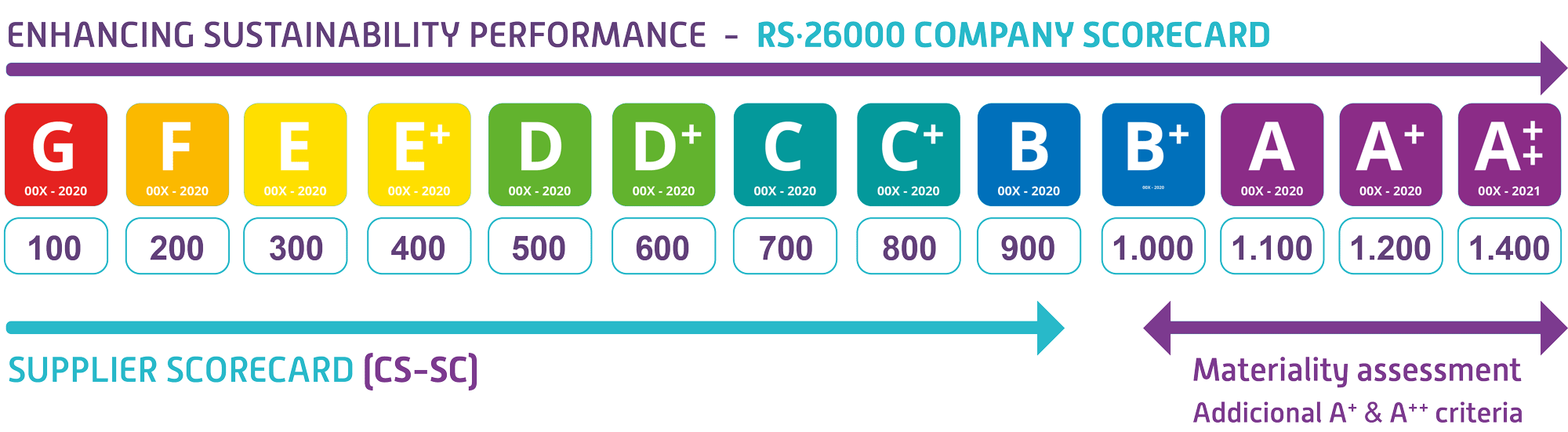
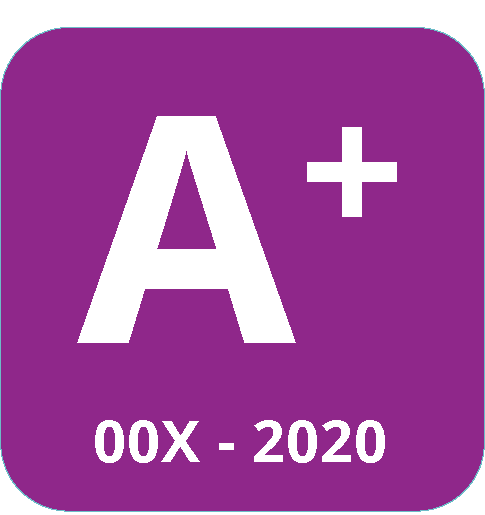
RS26000 INDEX EVALUATION
The RightSupply evaluation system transfers the numerical value of the RS26000 Index on a scale of letters from least to most sustainable and according to the following graph.
Organizations with A+ scores also meet the following [requirements].
RS 26000 ASSESSMENT BY CORE SUBJECTS
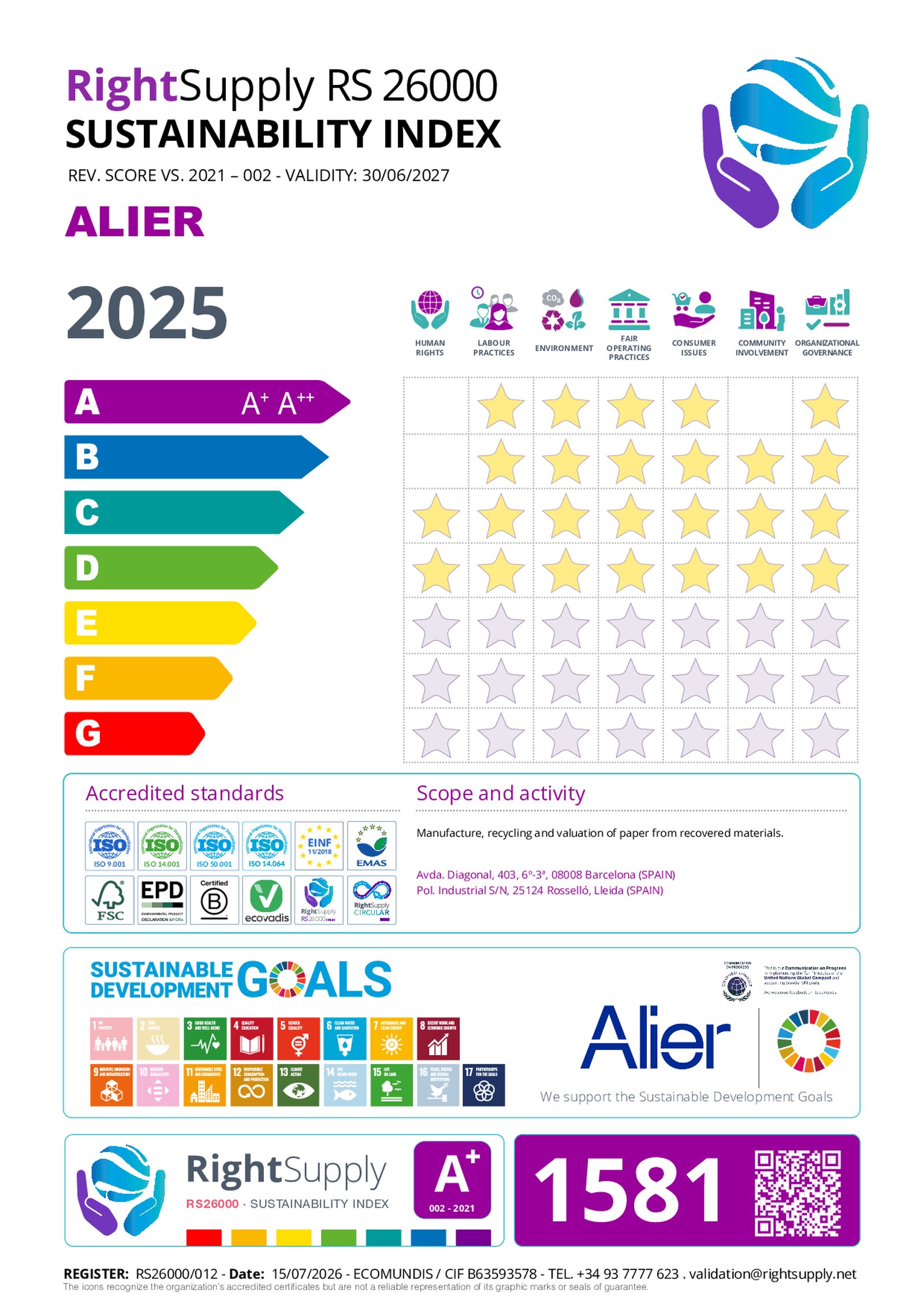
On the other hand, and in a complementary way, The organization's performance is evaluated numerically for each of the seven core subjects of Corporate Social Responsibility (ISO 26000) and using a scale that awards 7 points or stars. To recognize the efforts of organizations, the four highest-scoring stars will be distinguished with the color gold. This will allow the organization to quantify the total number of gold stars obtained cumulatively.

RS 26000 · CSI – COMPANY SUSTAINABILITY INDEX
Company Sustainability Index It is the evaluation and scoring system chosen by organizations to objectively analyze their progress in sustainability, progressively improve it, and communicate it to their customers and stakeholders.
Thanks to the information entered into the platform, the system automatically generates the RS26000 Report, facilitating the assessment and reporting of companies' corporate social responsibility. This report can be registered as a Communication on Progress (COP) document under the United Nations Global Compact.
RS 26000 · SVC – SUSTAINABLE VALUE CHAIN
Sustainable Value Chain it's a Supplier Sustainability Index assessment service for corporate supply chains. RS 26000 · SVC It reports annually to its organization indicators, aggregated and by supplier, on matters as important as the circular economy, climate change and other relevant aspects of good corporate governance.
Ref. GRI Standard: 2-5
◉ Verification log
ORGANIZATION: ALIER CENTER/s – COVERAGE: Manufacturing, recycling and valorization of paper from recovered materials.
This RS26000 report has been validated by:
Pablo Chamorro – ECOUNDIS
You can download the validated Master File here: RS26000-ALIER-2025.pdf
Date of last update: July 17, 2026 –
AUTOMATED TRANSLATIONS OF THIS SUSTAINABILITY REPORT: This SUSTAINABILITY/CSR/ESG REPORT has been verified in its original language. Browsers used by stakeholders to view it, or the RightSupply Platform itself, may automatically translate their direct transcription; however, the certifying body does not consider the translated content validated. For this reason, methods such as certified translation are recommended.
Template 2025 vs2.1



REPORTING AND VALIDATION


ISO 26000. Corporate Social Responsibility
ISO 26000 Scheme
Ref. VSME (CSRD-EU): B2.006 – GRI Standard: 2-29, 3-1, 3-2 – Ref. ESRS(CSRD):
In 2023, ALIER incorporated an initial materiality analysis specific to its main company in anticipation of its expansion in light of future European Union guidelines for sustainability reporting. This involved analyzing the materiality of the impact and, in a first phase, the general impact on its stakeholders, anticipating more significant stakeholder participation in the coming year. In 2024, ALIER will integrate the analysis of materiality and relevant aspects related to CSR and sustainability into its management system.Likewise, this analysis will take into account the 2030 Agenda and the 17 Sustainable Development Goals proposed by the United Nations.
Currently, the sector has identified several key aspects as relevant, which are already taken into account in ALIER's procedures and the attention it gives to its stakeholders. At a meeting of ALIER's management team and main shareholders in March 2022, the following aspects were highlighted as most relevant to the organization:
ENVIRONMENTAL AXIS
SOCIAL AXIS
GOVERNANCE AXIS
* NOTE: Negative impact values (above the 0 axis) and positive impact values (below the 0 axis) are shown. Use the RELATIVE IMPORTANCE selector % to filter by DOUBLE MATERIALITY relevance.
Ref. VSME (CSRD-EU): B2.005 – GRI Standard: 3-3d
Ref. GRI Standard: 3-3e